

Save This For Later
Ah, spring—the season of blooming flowers, chirping birds, and… trivia? Yep, you read that right!
As a mom of three, veteran teacher, and camp counselor with two decades under my belt, I’ve got an affinity for fun facts.
Trust me, you won’t find a more vibrant list of spring-inspired fun facts and trivia. Let’s get started, shall we?
💡Want more fun facts for kids? We have a full roundup of the best trivia questions for kids by grade, season, and topic.
Quick Facts About Spring
Looking for quick, surprising facts about spring? These kid-friendly highlights are perfect for classrooms, family trivia, and curious minds.
- Spring usually begins around March 20 with the vernal equinox
- Days grow longer as Earth tilts toward the sun
- Some animals can tell spring is coming before the weather changes by sensing longer daylight
- Thunderstorms in spring can help fertilize the ground with nutrients from the air
- Certain flowers can raise their own temperature to attract insects
- Spring is the only season when day and night start out almost equal
- Many animals see better colors in spring, helping them find food and mates
- Many animals migrate, mate, or give birth during spring
- Spring marks the start of pollen season, which can trigger allergies
- Across cultures, spring is often seen as a symbol of renewal and new beginnings
Spring Trivia and Fun Facts for Kids
1. Your sense of smell improves in Spring 🌷
With new flowers blooming, spring is a feast for the sense of smell. In fact, studies show that people’s ability to detect smells improves in spring!
Source: Chemical Senses Journal; “Seasonal Variation in Human Olfactory Performance”
Planning outdoor learning adventures? Our complete trivia resource includes spring questions plus nature-based activities for curious explorers.
2. The Eiffel Tower Grows in Spring 🗼
Incredibly, the Eiffel Tower can expand by up to 6 inches in the warmer temperatures of spring. This is because iron expands when it heats up. Don’t worry, it’ll shrink back when the weather cools down.
Source: Live Science; “Why Does the Eiffel Tower Expand in the Heat?”
3. Day and Night are Almost Equal in Spring
During the spring equinox, day and night are almost equal in length, which is why the term “equinox” comes from Latin words meaning “equal night.”
The word “vernal” comes from the Latin word ‘vernalis,’ which is derived from ‘ver,’ meaning spring. This equinox marks the first day of the season in the Northern Hemisphere.
Source: National Aeronautics and Space Administration (NASA)
Keep the seasonal learning going year-round with our treasure chest of facts that will wow your kids in every subject.
4. The Great Sphinx faces the sun directly.
During the time of the vernal equinox, the Great Sphinx in Egypt faces the rising sun directly.
Source: Archaeoastronomy Journal
5. Chichen Itza and Spring Equinox 🗿
On every equinox, the sun of the late afternoon creates the illusion of a snake creeping slowly down the northern staircase. Symbolically, the feathered serpent joins the heavens.
6. Monarch Butterflies Travel Thousands of Miles 🦋
Monarch butterflies undertake one of the longest insect migration routes. They travel thousands of miles from Mexico to the United States and Canada, arriving with the warmer weather in spring.
Source: National Geographic; “Monarch Butterfly Migration”
7. Arctic Terns: World Record Holders 🏆
Arctic Terns hold the record for the longest migratory journey in the animal kingdom. These birds can fly from the Arctic to the Antarctic and back, covering around 25,000 miles in a single year.
Source: Audubon Society; “The Amazing Arctic Tern”
8. Gray Whales Make a Mammoth Journey 🐋
Gray whales make one of the longest migrations of any mammal, traveling up to 12,000 miles round-trip between Mexico and Alaska.
Source: National Marine Fisheries Service; “Gray Whale Migration”
9. Salmon’s Incredible Uphill Battle 🐟
In late spring, salmon make their incredible upstream journey to spawn. Some species can leap up to 12 feet in the air to overcome obstacles like waterfalls.
Source: U.S. Fish & Wildlife Service; “The Salmon’s Uphill Battle”
10. Swallows come back to the same nesting sites every spring. 🐦
The arrival of swallows in various parts of the United States is often considered a harbinger of spring. They come back to the same nesting sites year after year.
Source: Cornell Lab of Ornithology; “Swallow Migration Patterns”
11. Arctic Migration: A Polar Phenomenon 🐋
In the North Pole region, spring is a time for one of the largest mammal migrations. Animals like whales and seals journey to the Arctic to take advantage of the months of uninterrupted daylight and abundant food resources.
Source: Arctic Council; “Arctic Animal Migration”
12. Rainbows are Unique to Planet Earth.
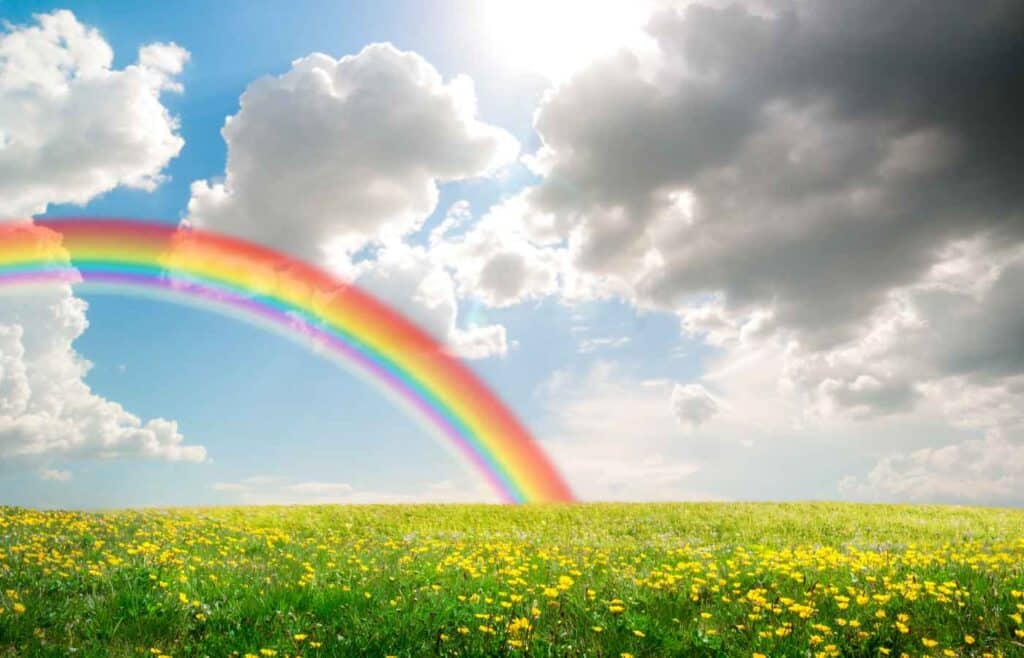
Earth is the only planet in the solar system where rainbows occur. Here are 25 more mind-blowing rainbow facts.
13. Arbor Day: A Day for Trees 🌳
Arbor Day is a holiday observed in many countries by planting trees. In the United States, it’s typically celebrated in late April, as this time of year offers optimal planting conditions.
Source: Arbor Day Foundation; “History of Arbor Day”
14. Mother’s Day Origins 💐
Mother’s Day was first officially recognized in the United States in 1914. It’s always celebrated on the second Sunday in May.
Source: Library of Congress; “The History of Mother’s Day”
15. Earth Day’s Beginning 🌏
Earth Day was first celebrated on April 22, 1970, and it led to the creation of the U.S. Environmental Protection Agency.
Source: Earth Day Network; “The History of Earth Day”
16. Cinco de Mayo History 🎉
Contrary to popular belief, Cinco de Mayo is not Mexico’s Independence Day but commemorates the Battle of Puebla on May 5, 1862. It’s more widely celebrated in the United States than in Mexico.
Source: History.com; “Cinco de Mayo”
17. The Groundhog Day Tradition 🐾
The tradition of Groundhog Day in the United States can be traced back to a German custom and has its roots in an older European weather lore that involved a badger or a sacred bear as the prognosticator. When German immigrants settled in Pennsylvania, they switched to using a groundhog as the predictor of whether there would be six more weeks of winter or an early spring.
Source: History.com; “Groundhog Day 2021: Punxsutawney Phil Predicts 6 More Weeks of Winter”
18. Ancient New Year Celebrations 🎆
In ancient Rome, the new year was originally observed on the first day of spring, as it was considered a time of new life and rebirth.
Source: Encyclopaedia Britannica; “Roman Calendar”
19. April Fool’s Day: The Calendar Confusion 📆
The origin of April Fool’s Day is a bit of a mystery, but one popular theory suggests it began in the 16th century when France switched from the Julian calendar to the Gregorian calendar. Those who failed to realize that the new year had moved to January 1st and who continued to celebrate during the end of March and April 1st became the target of pranks and jokes.
💡Looking for some hilarious ways to celebrate? Check out our 50 Hilarious April Fools’ Pranks for Kids and Parents for family-friendly tricks and fun ideas!
Source: History.com; “April Fools’ Day: Origin and History”
20. The Old English Origin
The term “spring” originates from the Old English word ‘springan,’ which means to leap or burst forth—a perfect description for a season bursting with life!
Source: Oxford English Dictionary
21. A Tale of Two Hemispheres
While the Northern Hemisphere welcomes spring, the Southern Hemisphere is entering autumn. Different sides of the world, different seasons!
Source: Timeanddate.com
22. The Lengthening of Days
From the vernal equinox to the summer solstice, the Northern Hemisphere experiences increasingly longer days.
Source: U.S. Naval Observatory
23. April Showers: A Literary Heritage
The adage “April showers bring May flowers” isn’t just something your grandma used to say—it has historical roots. The phrase can be traced back to the 16th century and even earlier. It appears in a poem written by Thomas Tusser in 1557, as part of a collection called “A Hundred Good Points of Husbandry.” The saying captures the essence of spring weather patterns in many regions, where a wetter April paves the way for the floral blooms of May. Not just a catchy saying, it’s a meteorological observation that has stood the test of time.
Source: The Phrase Finder; “A Hundred Good Points of Husbandry” by Thomas Tusser
24. It’s Not Just You: Spring Fever is Real
Ah, spring fever! That mix of restlessness and increased energy as the days get longer and the weather warms up. But did you know it’s not just humans who experience this? Animals do too!
Spring fever is a biological reality caused by changes in hormones like serotonin, which affects mood and energy levels. For animals, it’s a critical period for activities like hunting, mating, and preparing for the challenges of the year ahead. Scientific studies have documented that animals ranging from birds to mammals experience physiological changes that can be described as their version of ‘spring fever.’
Source: National Institutes of Health; “Seasonal Changes in Human Brain Serotonin Transporter Binding” (Research Article)
25. Some trees don’t make leaves until after they flower 🌳
Trees like magnolias and redbuds bloom before growing leaves. This helps pollinators spot the flowers more easily and allows the tree to use stored energy from winter.
Source: U.S. Forest Service
26. Cherry Blossom Openings: A Japanese Tradition
In Japan, the opening of the cherry blossom is culturally significant and signals the start of spring.
Did you know that cherry blossoms in Japan symbolize the transient nature of life? Yep, they’re not just pretty to look at; they’ve got depth!
Source: Japan Meteorological Agency
27. Spring Cleaning 🧹
The practice of spring cleaning has roots in various cultures. Whether it’s the Persian tradition of “khooneh tekouni,” which literally means “shaking the house,” or the Jewish custom of cleaning before Passover, the message is the same: out with the old, in with the new!
Source: The Washington Post; “The Most Productive Ways to Do Spring Cleaning, According to Experts”
28. Spring Break Origins 🎉
Spring break has its roots in the 1930s when it was originally conceived as a period for college swim teams to practice. Fast forward to today, and it’s evolved into a much-anticipated week of relaxation and fun in the sun for people of all ages.
Source: TIME; “The Surprising History of Spring Break”
29. Allergy Season 😷
Spring marks the start of allergy season for many, because it’s the start of the pollen season. As trees and flowers begin to bloom, pollen fills the air, becoming a nuisance for allergy sufferers everywhere. Hay fever rates tend to peak in spring due to the increased pollen count. While not severe for most, it can exacerbate conditions like asthma.
Source: American College of Allergy, Asthma, and Immunology; “Seasonal Allergies: Which Medication is Right for You?”
30. Daylight Saving ⏰
Daylight Saving Time usually begins in the spring to make better use of daylight. However, it’s worth noting that not all countries participate in this practice.
Source: National Geographic; “Daylight Saving Time 101”
31. Ode to Spring 📜
Spring has inspired poets for centuries. Robert Frost’s “A Prayer in Spring” and Emily Dickinson’s “A Light exists in Spring” are just a couple of examples of poems that celebrate this season of renewal.
Source: Poetry Foundation; “Spring Poems”
32. Baby Animals Galore 🐣
Spring is often considered “baby animal season.” Many animals give birth in the spring to take advantage of the abundant food.Source: National Geographic Kids
33. Worm Sign 🐛
Ever heard of “worm moon?” It’s the name for the full moon in March, signaling that earthworms—and robins—are soon to return!Source: Almanac for Kids
34. Ladybug Luck 🐞
Ladybugs are more active in the spring and are considered good luck. Plus, they help gardeners by eating pests!Source: Science Kids
35. Easter Eggs 🐰
The tradition of an Easter egg hunt has roots in the belief that finding eggs brings good luck and prosperity.Source: Kids Britannica
36. Chocolate Bunnies 🍫
Did you know over 90 million chocolate bunnies are made each year for Easter, a holiday that often falls in spring?Source: History for Kids
37. Grass is Greener 🌱
Grass appears greener in the spring because of increased sunlight and moisture. Source: Wonderopolis
38. Vernal Pools: Temporary Wonders 💧
Early spring leads to the formation of “vernal pools”—temporary bodies of water—that provide crucial habitats for certain kinds of flora and fauna.
Source: U.S. Fish and Wildlife Service; “Vernal Pools”
39. Facebook’s Seasonal Studies 📊
A Facebook study found that people tend to post less but engage more with what’s posted during spring compared to the long winter months.
Source: Facebook Research; “Seasonal Behavior Patterns”
More Spring-Related Facts:
40. Hours of Daylight
During the equinox, the North and South Poles receive 24 hours of daylight.
Source: National Geographic; “Everything to know about the March equinox”
41. First Spring Flowers
The snowdrop is often one of the first flowers to bloom in the spring.
Source: The Old Farmer’s Almanac; “First Flowers of Spring”
42. March 20th marks the beginning of spring.
The March equinox, which usually falls on March 20th, marks the official beginning of spring in the Northern Hemisphere.
Source: TimeAndDate; “March Equinox”
43. Is it spring yet? That depends.
Spring starts at different times depending on the time zone you’re in.
Source: The Conversation; “Why Spring gets about 30 Seconds Shorter every year”
44. Average Temperatures
Spring sees a rise in average temperatures as the Earth tilts towards the Sun.
Source: Climate.gov; “The Seasons, the Equinox, and the Solstices”
45. First Signs of Spring
One of the first signs of spring is the appearance of buds on trees.
Source: The Guardian; “Signs of Spring: what to look for”
46. 14th Century
The term “spring” originated in the 14th century, derived from the verb “springen,” meaning to “burst forth.”
Source: Online Etymology Dictionary; “Spring”
47. Baby Birds
Spring is when most baby birds are born.
Source: Audubon Society; “When Do Baby Birds Arrive?”
48. Earth’s Tilt
Spring occurs because of the Earth’s tilt on its axis, not its distance from the Sun.
Source: National Weather Service; “The Reason for the Seasons”
49. Spring thunderstorms help balance Earth’s atmosphere ⛈️
Spring storms don’t just bring rain — lightning helps convert nitrogen in the air into a form plants can use, acting like a natural fertilizer for soil.
Source: National Weather Service
50. Many animals shed their winter coats in spring
Animals like deer, foxes, and rabbits lose their thick winter fur as temperatures rise, replacing it with a lighter coat better suited for warmer weather.
Source: National Wildlife Federation
That’s a Wrap on Spring Trivia!
So there you have it, a treasure trove of interesting facts and fun spring facts to enrich your season. We hope this list adds a sprinkle of joy and a dash of knowledge to your springtime festivities.
Thanks for hanging with us, and here’s to a spring filled with laughter, sunshine, and perhaps a trivia win or two. Happy Spring!
Spring Into More Knowledge
If you’ve enjoyed this trivia journey, be sure to check out our other trivia-centric posts. We’ve got plenty more interesting facts on various seasons and holidays that you won’t want to miss!
- 100 Funny March Jokes
- St. Patrick’s Day Facts for Kids
- A Parent’s Guide to the Spring Cicada Emergence

Calie Herbst, Editor-in-Chief of Milwaukee With Kids, has spent over a decade combining her experiences as a parent of three to create a hub for Milwaukee’s family adventures.
Her decade-long teaching career in Milwaukee Public Schools and academic background, including a Master’s in Teaching from Marquette University and dual B.A.s in Sociology and Spanish from the University of Wisconsin – Madison, fuel her passion for inclusive and engaging family content.
Calie is also a recognized voice in local media, contributing to WISN Channel 12 News, WTMJ Wisconsin Morning News, Fox 6’s Real Milwaukee, and B93.3.
Discover more about Calie’s journey and editorial approach on her About Page and Editorial Policy Page.