

Tigers are powerful, mysterious, and full of surprises. Did you know their saliva is antiseptic, they have “false eyes” on the backs of their ears, and no two tigers have the same stripe pattern?
Here are 100 fun and fascinating tiger facts your kids will love.
💡Is your child wild about animals? Explore our full collection of animal facts for kids.
Quick Tiger Facts for Kids
Tigers are full of surprises! Before we dive into all 100 facts, here are a few quick tiger facts kids love to learn right away.
- Scientific name: Panthera tigris
- Largest wild cat on Earth — bigger than lions
- Teeth up to 4 inches long and a bite force of about 1,000 pounds
- Can leap up to 32 feet in a single jump
- Excellent swimmers (unusual for big cats!)
- Night vision 6× better than humans
- Stripes are as unique as fingerprints — no two tigers are the same
- Can eat up to 80 pounds of meat in one night
- Wild population: ~3,900 tigers left
- Conservation status: Endangered
Tiger Size & Strength Facts
Tigers are the largest wild cats in the world, even bigger than lions.
Male tigers can weigh up to 680 pounds and grow up to 10 feet long from nose to tail.
A fully grown tiger can stand about three feet tall at the shoulder.
Adult tigers can grow up to 10 feet long.
A tiger’s teeth can reach four inches long, and its claws can grow up to three inches, making it an extremely powerful hunter.
A tiger’s tail can be around three feet long, helping it balance while running, jumping, and hunting.
Sumatran tigers are the smallest tiger subspecies. They have narrower black stripes and thicker fur, which helps them camouflage more effectively in the dense Indonesian jungle.
Tigers belong to the “big cat” family, along with lions, cheetahs, jaguars, and cougars.
Sources: National Geographic Kids, Kids Britannica, Denver Zoo, Zoological Society of London
💡Tigers aren’t the only massive animals with amazing abilities. Don’t miss these mind-blowing Facts About Elephants or these amazing Rhino Facts for Kids.
Tiger Appearance & Stripes
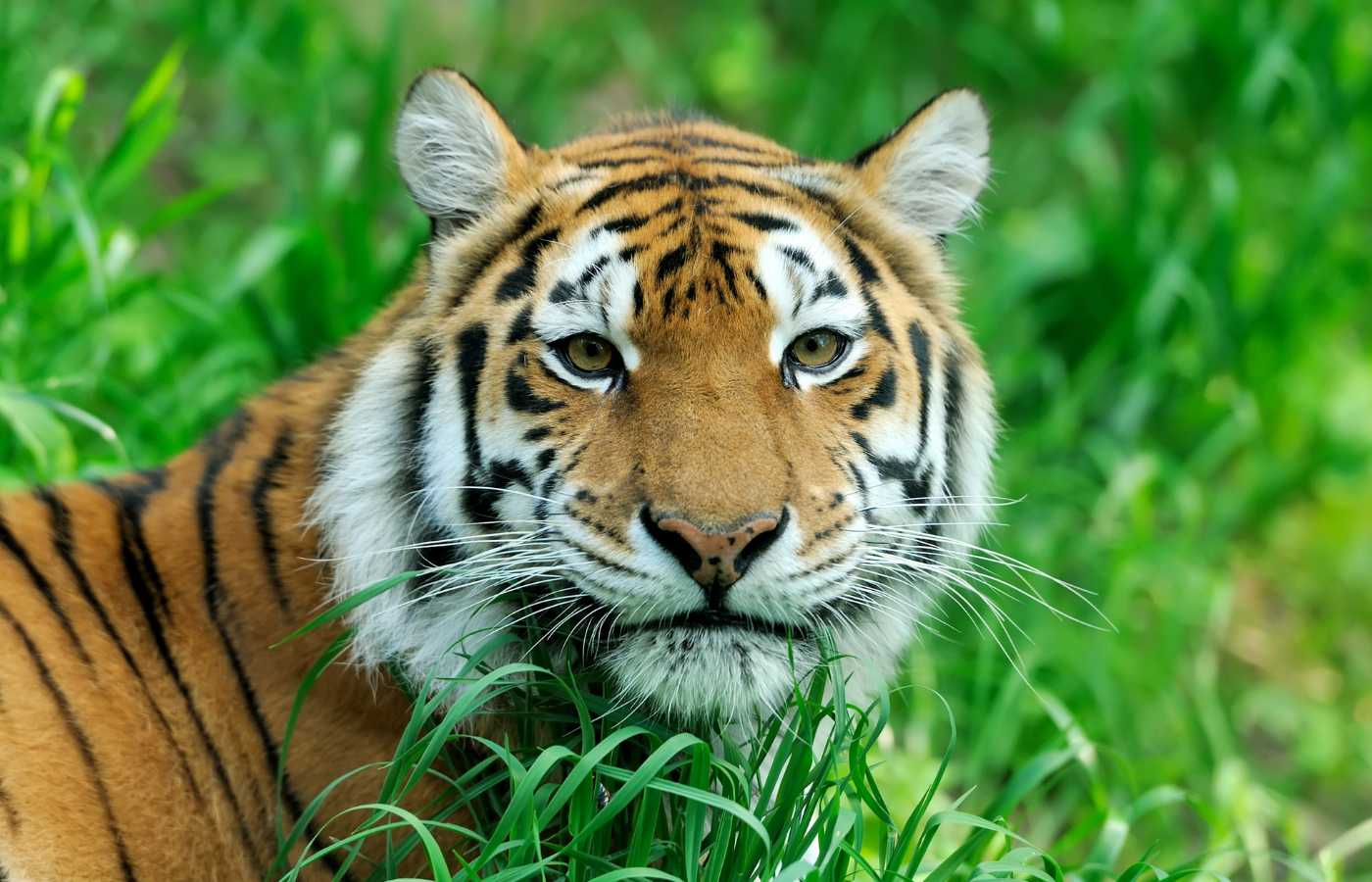
Most tigers have light yellow fur on their bellies and deep yellow or orange fur on their backs, helping them blend into their surroundings.
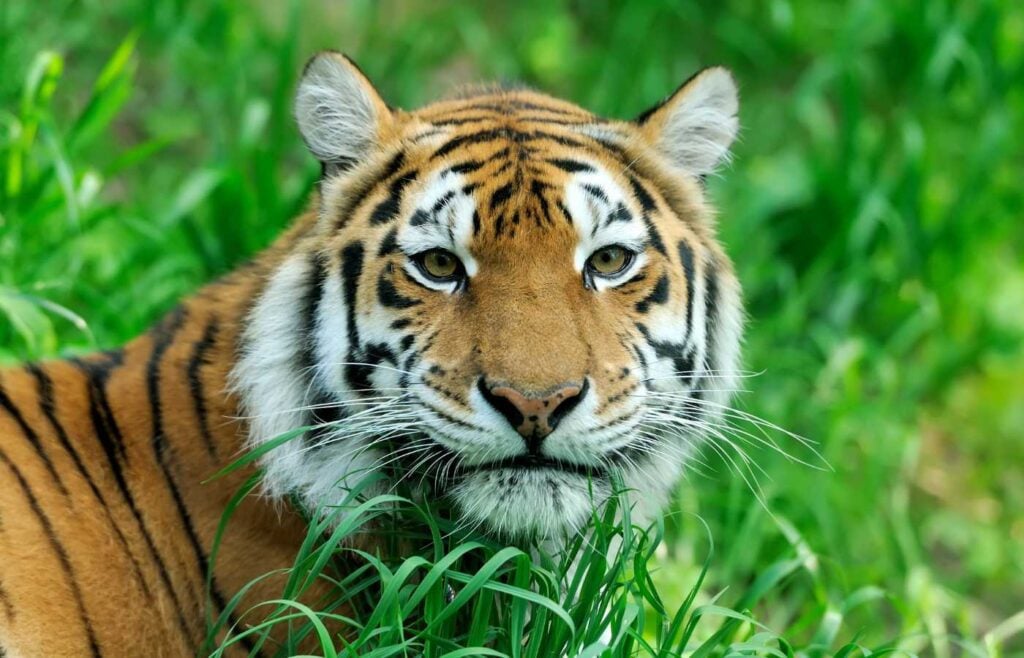
Dark stripes cover a tiger’s head, body, and legs, with black rings wrapping around the tail.
Some tigers are white with black stripes or appear almost entirely white. These tigers aren’t a separate species — they are a rare color variation. (You can learn more in our white tiger facts for kids guide.)
A tiger’s stripes act as camouflage, especially during the day, breaking up its outline in tall grass and forests.

No two tigers have the same stripe pattern. Their stripes are as unique as human fingerprints — even identical twins don’t match.
Tigers have soft toe pads that help them move silently through their habitat while stalking prey.
They also have distinctive white circular spots on the backs of their ears, often called “false eyes.” These markings can make a tiger appear larger and may scare off predators approaching from behind.
Sources: Kids Britannica, WWF, National Geographic Kids, SeaWorld
Where Tigers Live (Habitat Facts)Tigers live in the wild across parts of Russia, China, and South and Southeast Asia.
The country with the largest number of wild tigers is India, which is home to around 3,000 of the world’s remaining tigers.
Tigers can be found in a variety of habitats, including forests, grasslands, and swamps.
These big cats are solitary animals and prefer to live far apart from one another, rather than in groups.
In their natural habitat, a single tiger ideally needs about 20 square miles of space to roam, live, and hunt. Captive tigers almost never have access to this much living space.

Tigers are highly territorial. They mark trees with urine and scratch marks to signal to other tigers that the area is already claimed.
Despite their association with warm climates, tigers can live in very cold environments. Some populations survive in cold regions of India and Southeast Asia.
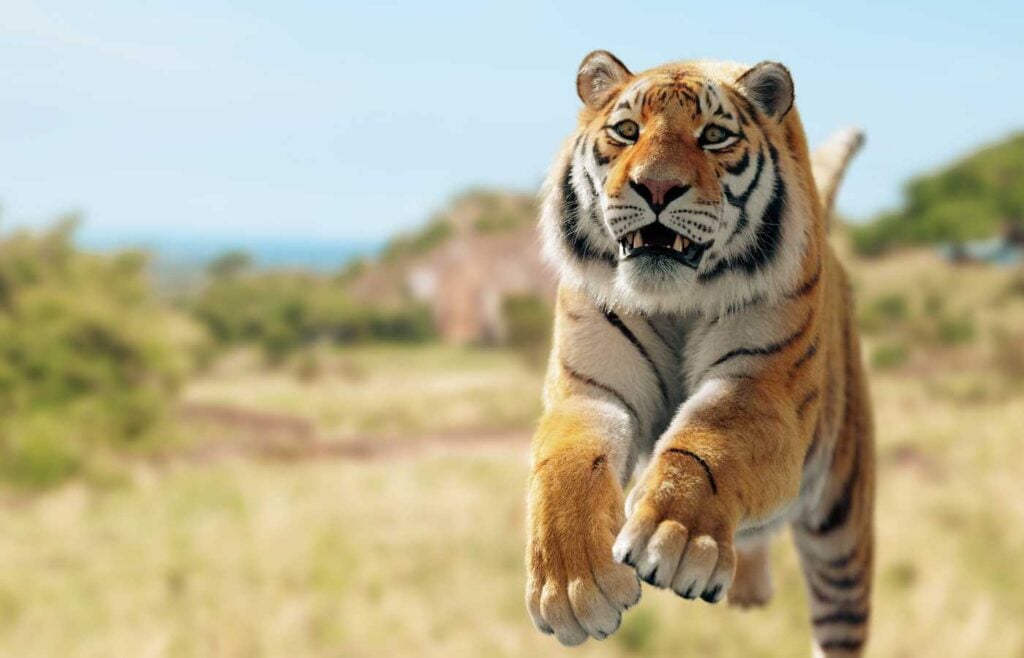
Tigers are also powerful jumpers and can leap up to 32 feet in a single bound.
In the wild, a tiger’s average lifespan is about 8 to 10 years.
Sources: Kids Britannica, National Geographic Kids, World Wildlife Fund
What Do Tigers Eat? (Food & Hunting Facts)
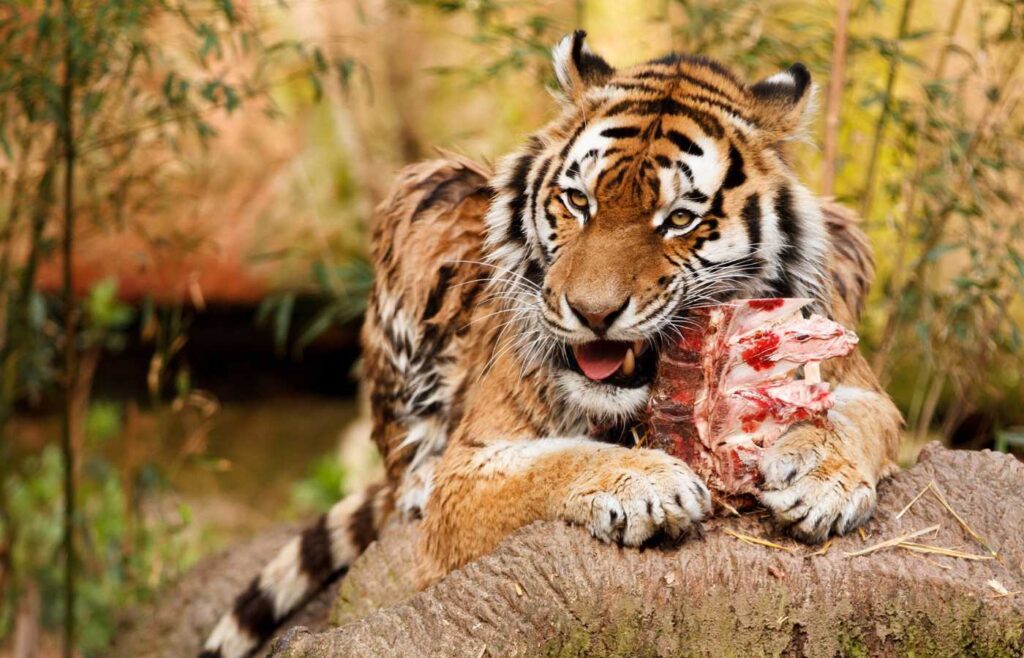
Tigers are carnivores, which means they eat meat.
They prefer to hunt large mammals such as deer, antelope, and buffalo, but they generally avoid extremely large animals like elephants and bears. Tigers also try to stay away from people.
Tigers are opportunistic predators, meaning they will eat what’s available. In addition to large prey, they may also eat wild boar, birds, fish, rodents, amphibians, reptiles, and even insects.
Tigers usually hunt alone and at night. They quietly stalk their prey and kill it with a powerful bite to the neck or back of the head.
Their bite is incredibly strong — tigers can bite down with a force of about 1,000 pounds, helped by their four-inch-long, sharp teeth.
Tigers have excellent night vision. Their eyes have a special structure that allows them to see up to six times better than humans in the dark.
During a night of hunting, a tiger may travel between 6 and 12 miles while searching for food.
Tigers can even mimic the sounds of other animals to fool prey as they approach.
When successful, a tiger can eat up to 80 pounds of meat in a single night, though a more typical meal is closer to 12 pounds.
If a tiger kills very large prey, it may take several days to finish eating it. Tigers are protective of their food and often drag their kill into cover. They may hide the carcass with leaves and dirt, returning later to eat more.
A single large deer can provide enough food for a tiger for about one week.
Despite their strength, hunting isn’t easy — only about one out of every ten hunts is successful.
Interestingly, a tiger’s taste buds cannot recognize sweetness, so they don’t taste sugar the way humans do.
Because of their massive size and energy needs, a tiger could starve to death within two weeks without enough food.
Unlike many other big cats, tigers will share their food. Male tigers often allow female tigers and cubs to eat first.
Sources: National Geographic Kids, Kids Britannica, WWF, Zoological Society of London, Facts.net
Tiger Behavior & Abilities
Unlike most cats, tigers are excellent swimmers. They often cool off by relaxing in rivers and streams.
Tigers are also powerful jumpers and can leap up to 32 feet forward in a single bound.
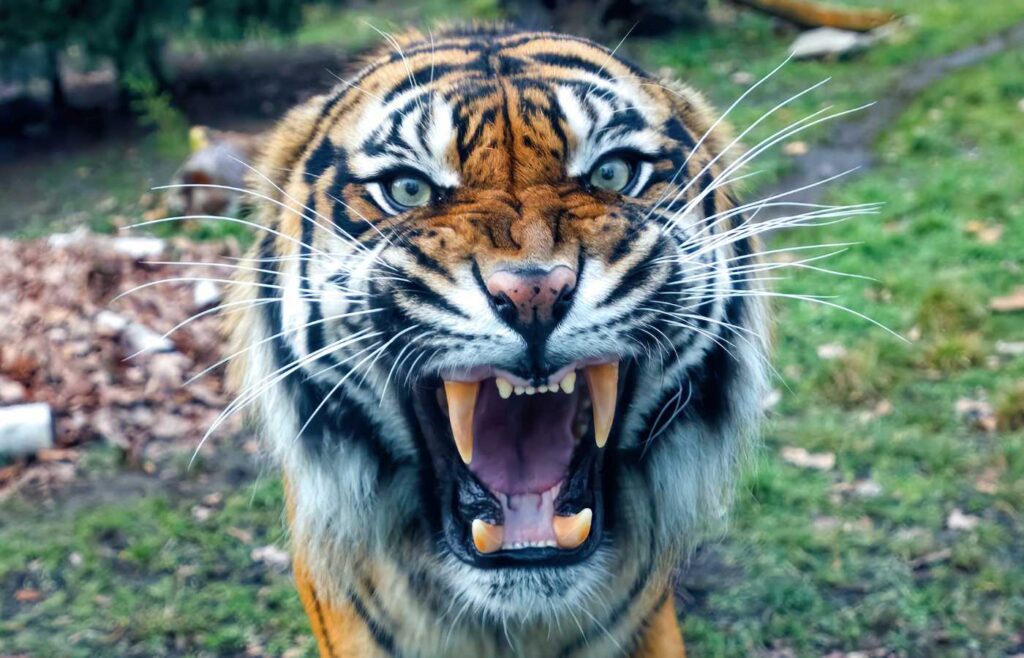
A tiger’s roar is incredibly loud — it can be heard from as far as three kilometers (nearly two miles) away.
Tigers are fast runners. They can run up to 65 kilometers per hour, which is about as fast as a car driving on the highway.
Tigers communicate using a wide range of sounds, including grunts, growls, moans, roars, snarls, and hissing.
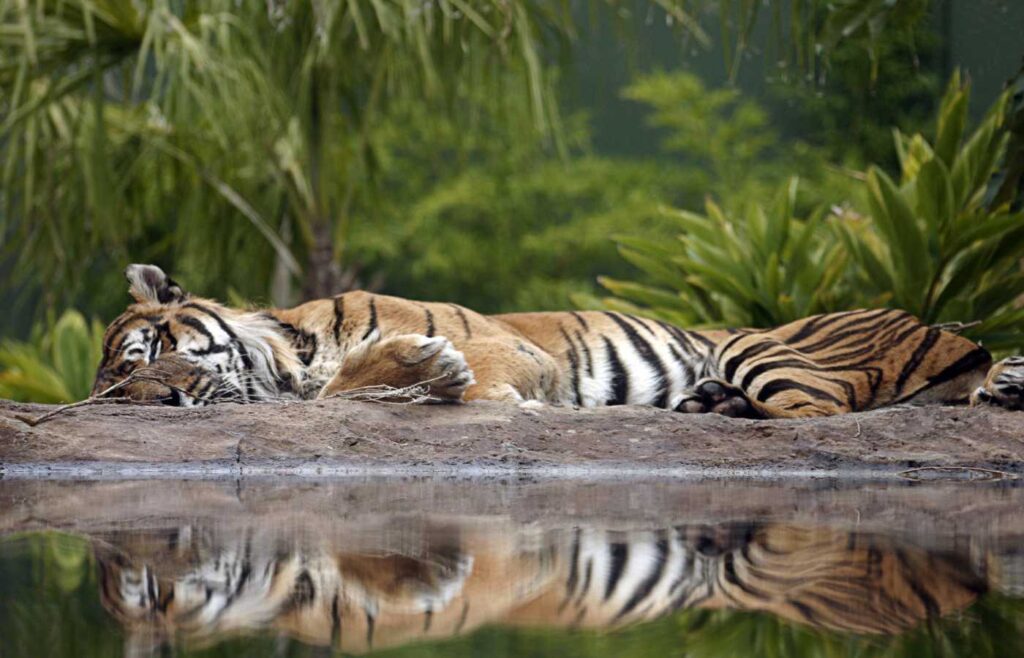
Because they do most of their hunting at night, tigers spend much of the day resting. A tiger can sleep for up to 18 hours a day, mostly during daylight hours.
Sources: National Geographic Kids, WWF, Zoological Society of London, Facts.net
Tiger Species & Subspecies
There are five living subspecies of tigers: the Bengal tiger, South China tiger, Indochinese tiger, Sumatran tiger, and the Amur tiger.
Sadly, three tiger subspecies have gone extinct: the Caspian tiger, Bali tiger, and Javan tiger.
Tigers share about 96.6% of their DNA with domestic cats, like the ones many people keep as pets.
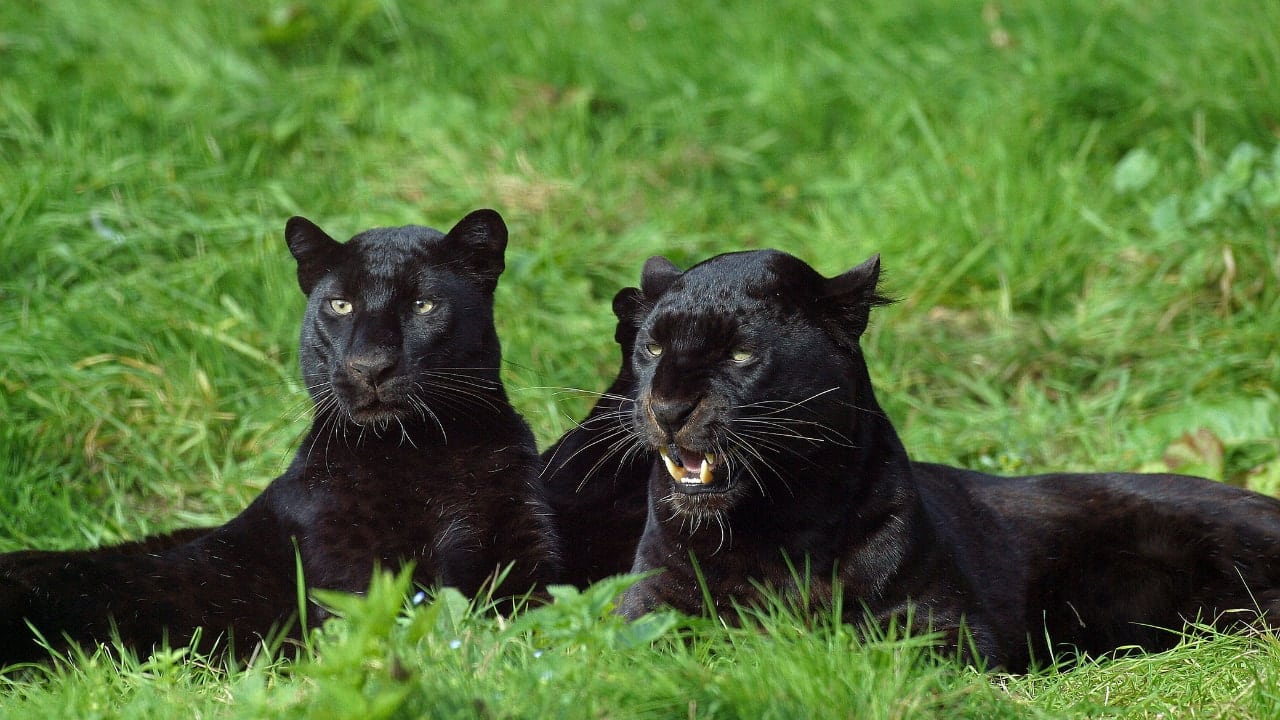
While not an official species, black tigers, also known as melanistic tigers, are extremely rare. Their stripes are so thick that their coats can appear almost completely black. (Kids curious about other dark big cats may enjoy learning about black panthers, too.)
A group of tigers is called a “streak” or an “ambush” of tigers.
Sources: National Geographic Kids, Kids National Geographic, Discovery UK
Tiger Cubs & Family Life
Tigers usually come together only during mating season or when hunting very large prey. Most of the time, adult tigers live alone.
Female tigers can give birth to litters of up to seven cubs, though many cubs do not survive due to disease, lack of food, or predators.
Tiger cubs are born completely blind and are entirely dependent on their mother. Their eyes begin to open between six and twelve days after birth, but they do not have full vision until they are about two weeks old.

All tiger cubs are born with blue eyes, which gradually change to gold as they grow. White tigers are the only tigers that keep their blue eyes into adulthood.
Newborn tiger cubs weigh between 1.75 and 3.5 pounds. They grow quickly — cubs can quadruple in size during their first month of life.
Tiger cubs begin eating meat at around 6 to 8 weeks old, though they continue to rely on their mother for food and protection.
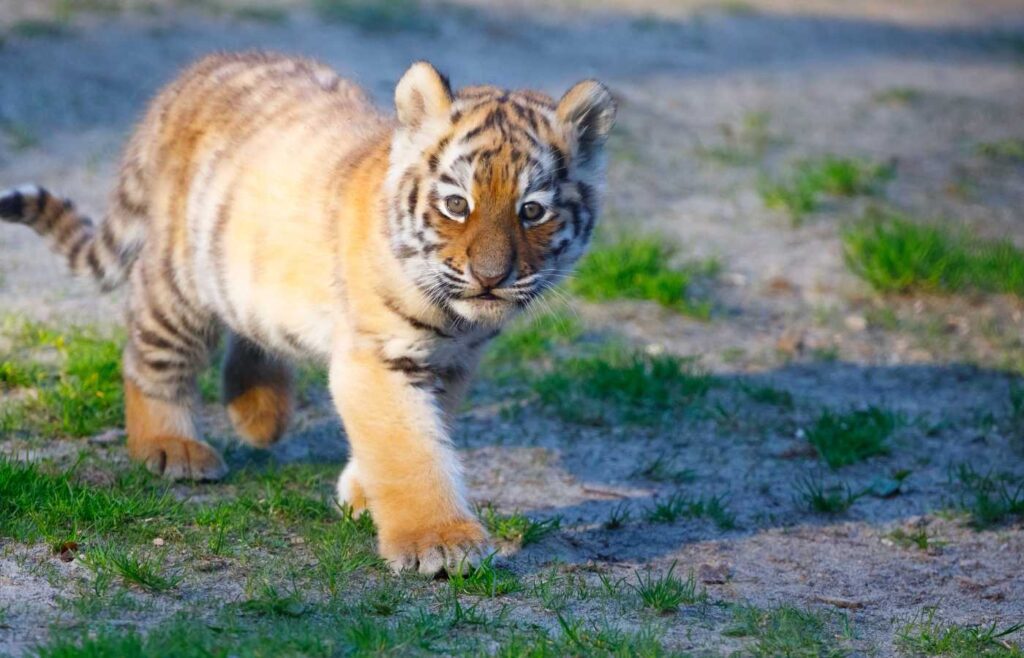
Mother tigers care for their cubs for about a year and a half, and cubs typically stay with their mother for around two years while learning how to hunt and survive.
When a mother tiger has a new litter, she will often chase older cubs away to force them to live independently. This is a dangerous stage of life — only about one in seven cubs survives on its own after leaving its mother.
In rare and extreme situations, infanticide can occur. If food is very scarce, a mother tiger may kill her cubs. Male tigers may also kill cubs in order to make a female available for mating. While disturbing, this behavior has been observed in the wild among some big cats.

Mating between tigers and lions does not usually happen in the wild, but it has occurred in captivity. A tigon is the offspring of a male tiger and a female lion, while a liger is the offspring of a male lion and a female tiger.
Sources: Kids Britannica, Wildlife Informer, SeaWorld, National Geographic Kids, Wild Explained, Ranthambore National Park
💡Tigers aren’t the only ones with fascinating family dynamics. Explore 50 Mind-Blowing Monkey Facts Your Kids Will Love to learn more about how primates raise their young.
Are Tigers Endangered?
Yes, tigers are endangered. Hunting and habitat loss have caused the global tiger population to decline by about 93% over the last 100 years.
Tigers are hunted for their fur and for parts of their bodies that are used in some forms of traditional medicine.
Their natural habitats have also been greatly reduced as land has been cleared for farming, logging, and human development.
Today, there are only about 3,900 tigers left in the wild.
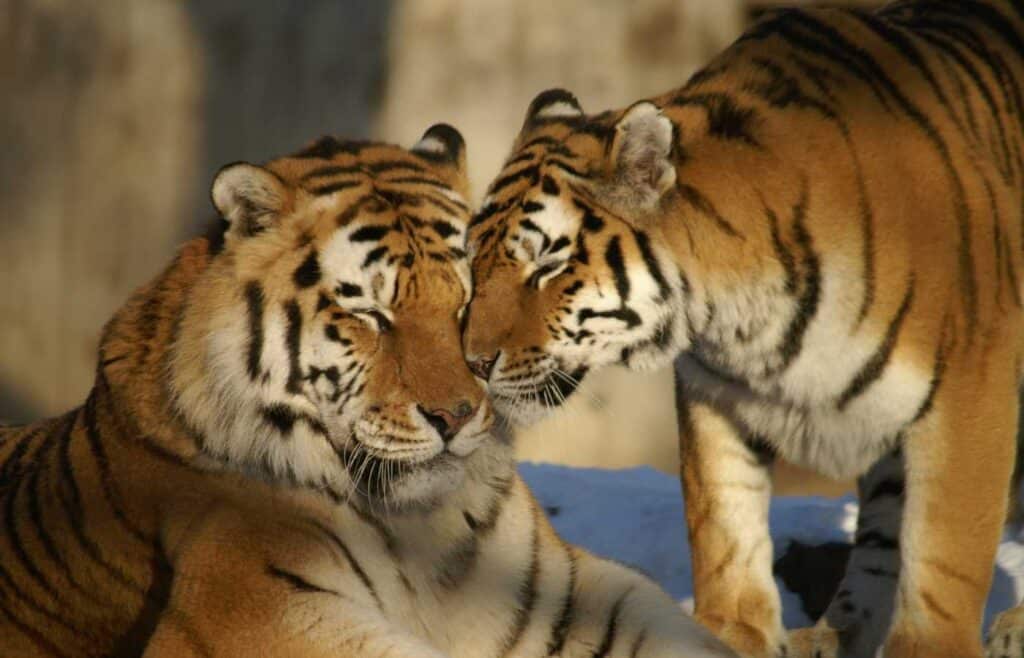
While tigers are endangered, it may be surprising to learn that there are more captive tigers in the United States than there are wild tigers in the entire world.
The Tasmanian tiger, also known as the thylacine, was not a true tiger but is often mentioned in discussions about extinction. It went extinct in 1936, when the last known individual died at Hobart Zoo in Tasmania.
Even though tigers are highly endangered, they still outnumber other big cats, such as cheetahs and snow leopards, in terms of total population.
Sources: National Geographic Kids, Kids National Geographic, World Wildlife Fund, Facts.net
Miscellaneous Tiger Facts & Human Connections
A tiger’s tail helps it keep its balance, especially when running, jumping, or turning quickly.
Fossil remains show that tigers have existed for at least 2 million years, with ancient tiger fossils discovered in China.
A tiger’s saliva is antiseptic. It helps them groom their fur, keep themselves clean, and clean wounds, which may help prevent infection.
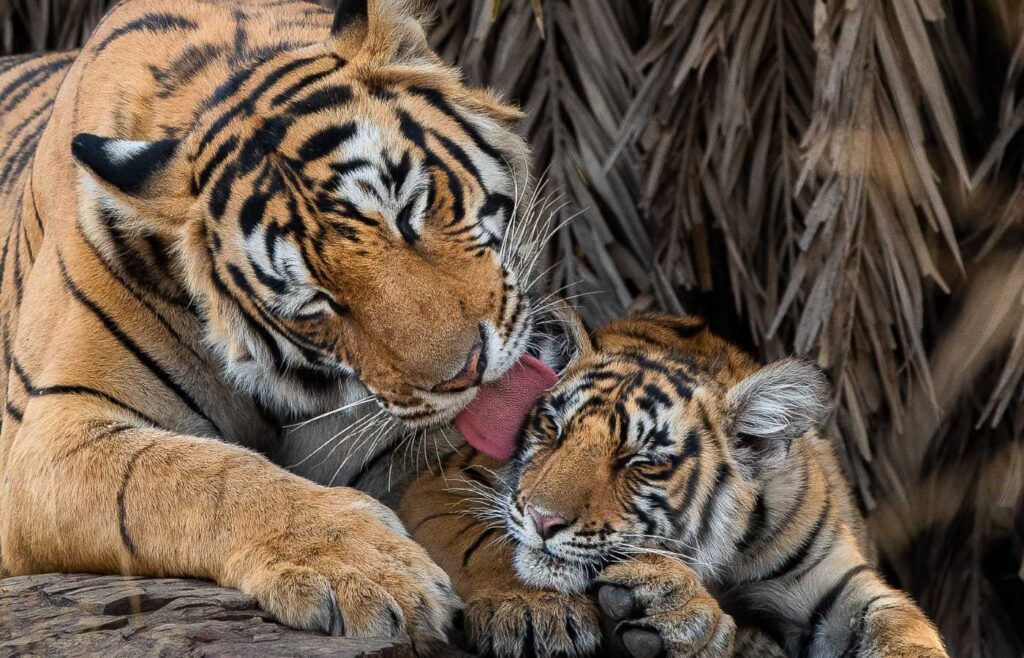
Interestingly, some scientists say that tiger urine smells like buttered popcorn.
Tigers are extremely powerful animals. A single strike from a tiger can be fatal to a human.
According to government data published in 2019, between 40 and 50 people are killed by tigers each year, most often in areas where humans and tiger habitats overlap.
In 1973, India declared the tiger its national animal, recognizing its cultural and environmental importance.
Sadly, tigers are also threatened by illegal wildlife trade. Adult tigers can be sold for up to $10,000 on the black market, contributing to their continued endangerment.
Sources: National Geographic Kids, National Geographic Kids, WWF, Wildlife Conservation Trust, Facts.net
White Tiger Facts (Myths vs Reality)
White tigers are not a separate species of tiger. All white tigers are a color variation of Bengal tigers, not a separate subspecies.
There is one tiger species with six subspecies: the Bengal, Siberian (Amur), South China, Sumatran, Indochinese, and Malayan tigers.
Despite common confusion, white tigers are not Siberian tigers. People often associate Siberia with snow, but white tigers are actually white Bengal tigers, not cold-climate Siberian tigers.
In the wild, white tigers are extremely rare, occurring in about 1 out of every 10,000 tiger births. They are only born when both parents carry a recessive gene for white coloring.
The white coat is caused by a rare genetic mutation involving the absence of pheomelanin, the pigment that gives Bengal tigers their orange color.
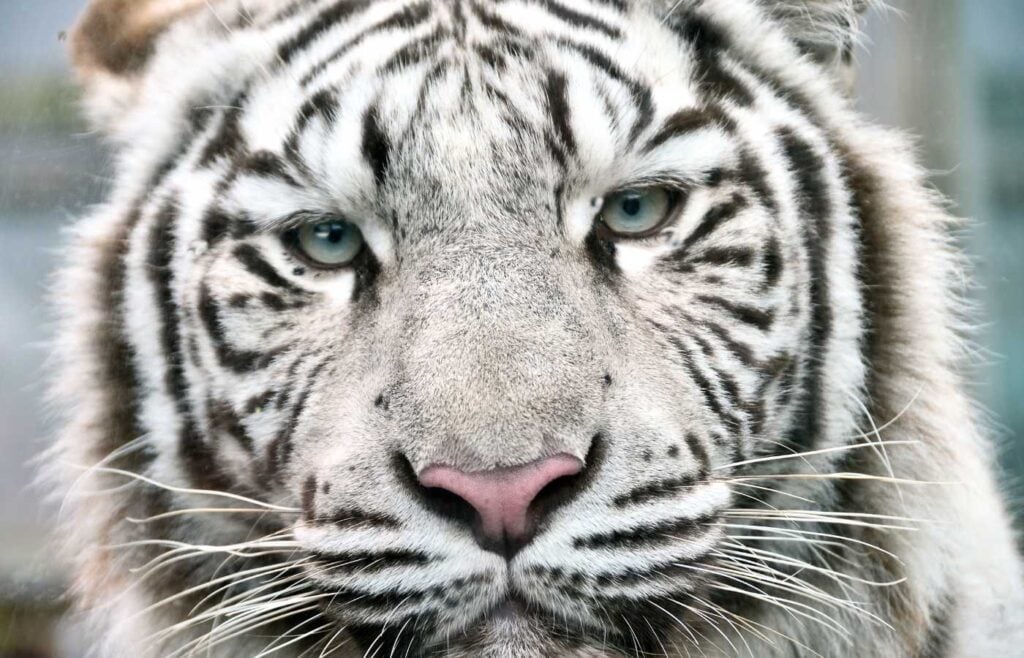
While striking, white fur makes survival harder in the wild. It provides little camouflage, making it more difficult for white tigers to stalk prey or avoid danger.
White tigers typically have blue eyes, while most orange Bengal tigers have yellow or gold eyes. The gene responsible for white fur is linked to the gene for blue eyes.
White tigers often have crossed eyes. This happens because the same gene that causes the white coat affects how the optic nerve connects to the brain, reducing vision and reaction time. Because of this, white tigers have historically been used by animal performers.
White tigers are often slightly larger than orange Bengal tigers, a difference noticeable at birth and believed to be linked to the same genetic mutation.
Even though their fur looks different, white tigers still have black stripes on their skin. If shaved, the stripe pattern would remain visible. As with all tigers, no two stripe patterns are the same — they are as unique as fingerprints.
A white tiger’s fur can change color with temperature. Like Siamese cats and Himalayan rabbits, they have enzymes in their fur that cause it to darken in colder conditions.
White tigers are not albino. Albinism involves a complete lack of pigment in skin and hair, which is different from the genetic mutation that causes white tigers.
The first recorded sighting of a white tiger dates back to India in the 1500s, documented in Akbar Nama, a historical record from the Mughal Empire.
The first documented capture of a white tiger occurred in 1915 in India, when a local maharaja captured the animal and kept it until its death.
Nearly all white tigers in captivity today can trace their ancestry to a single cub named Mohan, captured in India in 1951after his mother and siblings were killed. Mohan was given to the Maharajah of Rewa, who bred him with close relatives to produce more white tigers.
One of Mohan’s descendants, Mohini, was later brought to the National Zoo in Washington, D.C., spreading white tiger bloodlines throughout the United States.
White tigers gained worldwide attention through performances by Siegfried & Roy in Las Vegas. Their performing career ended in 2003 after a white tiger named Mantacore attacked Roy Horn during a show. Roy survived the incident.
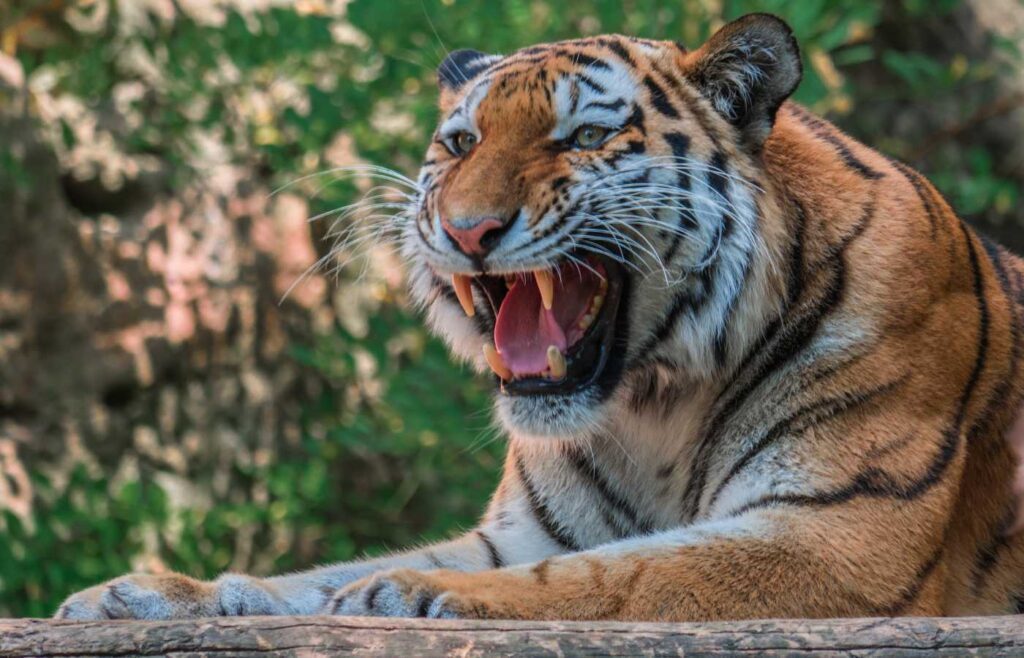
There are no known white tigers living in the wild today. The last known wild white tiger was killed in 1958 by a trophy hunter.
It’s estimated that only around 200 white tigers exist worldwide, all living in captivity in zoos, theme parks, or private collections. These tigers are the result of intentional inbreeding, not natural conservation efforts.
Inbreeding is extremely harmful to white tigers. It causes high cub mortality and serious health problems, including vision impairment, heart defects, spinal and facial deformities, weakened immune systems, and shorter lifespans.
White tigers are not an endangered species, because they are not a separate species at all. Tigers are endangered, with about 3,900 left in the wild. Facilities that promote white tigers as conservation animals are often exploiting them for profit.
To address this issue, U.S. federal legislation, including the Big Cat Public Safety Act (H.R. 263 / S. 1210), has been introduced to limit the unregulated breeding and exploitation of big cats.
💡Curious to learn more? We break down myths, genetics, and conservation concerns in our full guide to white tiger facts for kids.
Frequently Asked Questions About Tigers
Tigers live in the wild in parts of Russia, China, and South and Southeast Asia. Most wild tigers live in India, which is home to around 3,000 of the world’s remaining tigers. They can be found in forests, grasslands, and swamps.
(Sources: kids.britannica.com, wwf.org.uk)
Tigers are carnivores, meaning they eat meat. They mainly hunt large animals like deer, antelope, and buffalo, but they will also eat smaller prey such as wild boar, birds, fish, rodents, reptiles, and even insects. Tigers usually avoid very large animals like elephants and bears and tend to stay away from people.
(Sources: natgeokids.com, kids.britannica.com, wwf.org.uk)
Yes, tigers are endangered. There are an estimated 3,900 tigers left in the wild, and their population has dropped by about 93% over the past 100 years due to hunting and habitat loss. Forests have been cleared for farming and logging, and tigers are still hunted for their fur and body parts.
(Sources: wwf.org.uk, natgeokids.com, kids.nationalgeographic.com)
Tigers usually hunt alone and at night. They quietly stalk their prey and kill it with a powerful bite to the neck or back of the head. Tigers have excellent night vision, allowing them to see about six times better than humans in the dark.
(Sources: natgeokids.com, zsl.org, facts.net)
Tigers sleep for up to 18 hours a day, mostly during daylight hours. Since they hunt at night, daytime is usually their time to rest and conserve energy.
(Source: facts.net)
No. The Tasmanian tiger, also known as the thylacine, was not a true tiger at all. It went extinct in 1936 when the last known individual died at Hobart Zoo in Tasmania.
(Source: facts.net)
More Big Cat Facts Kids Love
Want to explore more big cats? Kids also love learning about fast and fierce felines like cheetahs, mysterious black panthers, and rare white tigers.
We hope you loved this list of interesting facts and frequently asked questions about tigers. They truly are incredible animals! To help tigers and support conservation efforts, head to the World Wildlife Fund.

Calie Herbst, Editor-in-Chief of Milwaukee With Kids, has spent over a decade combining her experiences as a parent of three to create a hub for Milwaukee’s family adventures.
Her decade-long teaching career in Milwaukee Public Schools and academic background, including a Master’s in Teaching from Marquette University and dual B.A.s in Sociology and Spanish from the University of Wisconsin – Madison, fuel her passion for inclusive and engaging family content.
Calie is also a recognized voice in local media, contributing to WISN Channel 12 News, WTMJ Wisconsin Morning News, Fox 6’s Real Milwaukee, and B93.3.
Discover more about Calie’s journey and editorial approach on her About Page and Editorial Policy Page.