

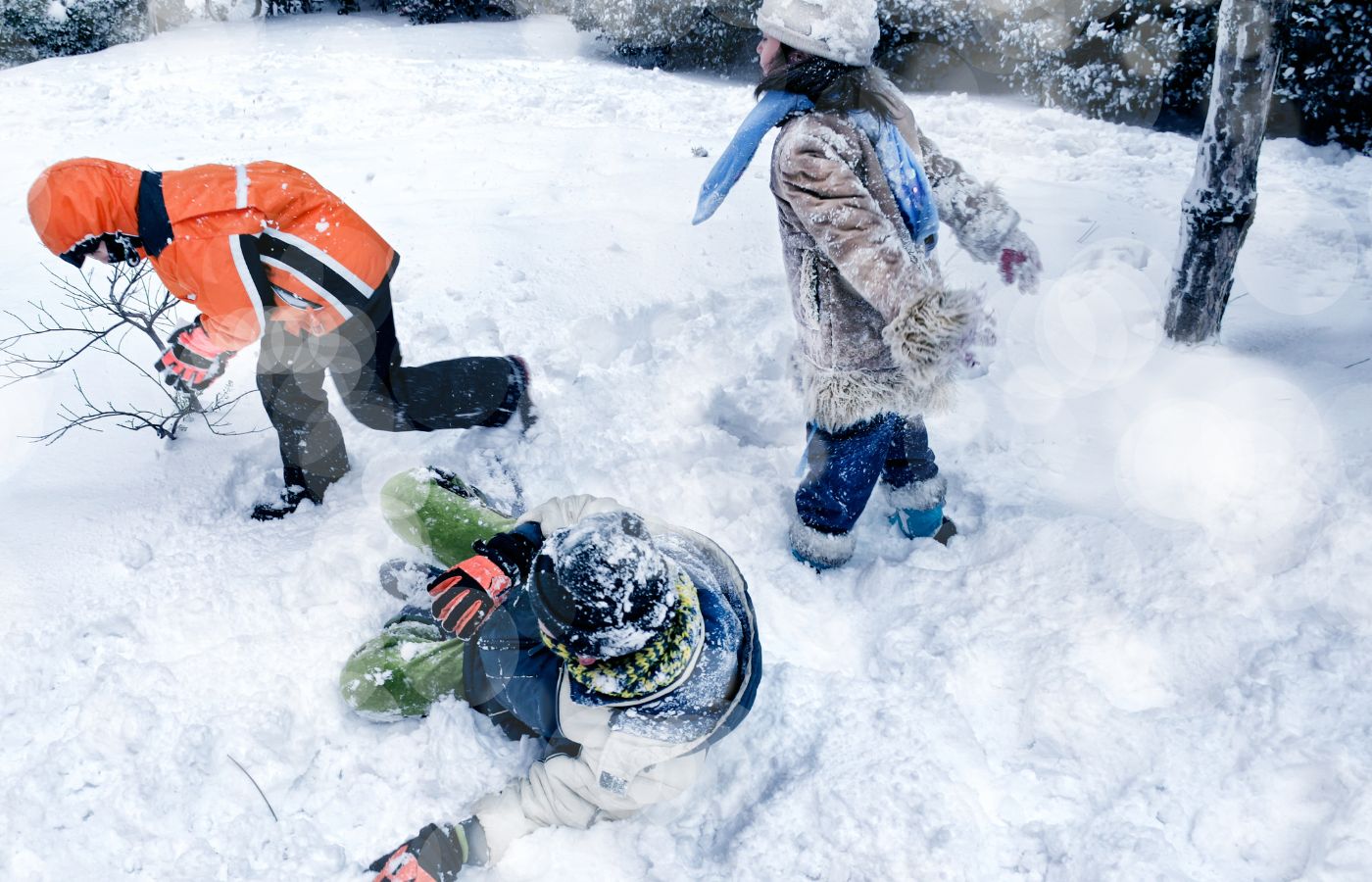
Winter is here, and the snow has started to fall! Kids everywhere are pulling on their boots and heading outside to play in the fluffy white stuff — but have you ever stopped to wonder what snow really is?
From how snowflakes form to record-breaking blizzards, these fun snow facts for kids will teach your family all about the magic of snow.
Want even more fun? Explore our full collection of Trivia Questions for Kids, covering every season, holiday, and topic.
Wild & Wacky Snow Facts
Before we get into how snow forms, let’s kick things off with some of the craziest, coolest, and most unbelievable snow facts out there:
- The world’s biggest snowflake was 15 inches wide and 8 inches thick! That’s bigger than a dinner plate.
- Monkeys have snowball fights. Seriously—Japanese snow monkeys make and toss them for fun.
- Snow isn’t white—it’s clear! It just looks white because sunlight bounces around all those ice crystals.
- Scotland has 421 words for snow. A few favorites: skelf (a big flake) and spitters (tiny flakes that sting your face).
- The Inuit have 50 words for snow—proof of how deeply snow is part of their world.
- A single snowflake can have up to 200 ice crystals, like a tiny frozen masterpiece floating from the sky.
- Capracotta, Italy, once got over 100 inches of snow in one day. That’s more than eight feet of snow in 24 hours!
- Igloos can be 100°F warmer inside than outside—just from body heat.
- Snow monkeys in Japan soak in hot springs all winter long. Total vibe.
- Seattle hosted the world’s largest snowball fight with nearly 6,000 people!
- “Thundersnow” is a real thing—it’s when lightning and thunder crash during a blizzard.
- It snows on Mars, but the flakes are made of carbon dioxide (dry ice).
- Snow keeps animals cozy. It’s 95% air, so it traps heat and makes the perfect winter blanket.
- Syracuse, New York, once made it “illegal to snow before Christmas Eve.” Nice try, Mother Nature.
- Fresh snow actually absorbs sound, which is why the world feels so calm after a big snowfall.
How Snow Forms
1. Each year, at least 1 septillion snowflakes fall from the sky.
That’s 1,000,000,000,000,000,000,000,000. (24 zeroes!)
2. Snow forms in clouds.
When the temperature is below freezing (less than 0ºC or 32ºF), snow begins to form in the clouds.
Love learning about winter? Test your knowledge with our winter trivia questions for kids
3. You need dirt to make snowflakes.
Snowflakes are made of tiny ice crystals that form on tiny bits of dirt in the air.
4. Snowflakes grow on the way down.
As the crystals of ice grow, they become heavier and fall toward Earth.
5. Some snowflakes are made of one single ice crystal.
6. Other snowflakes are made of up to 200 ice crystals joined together.
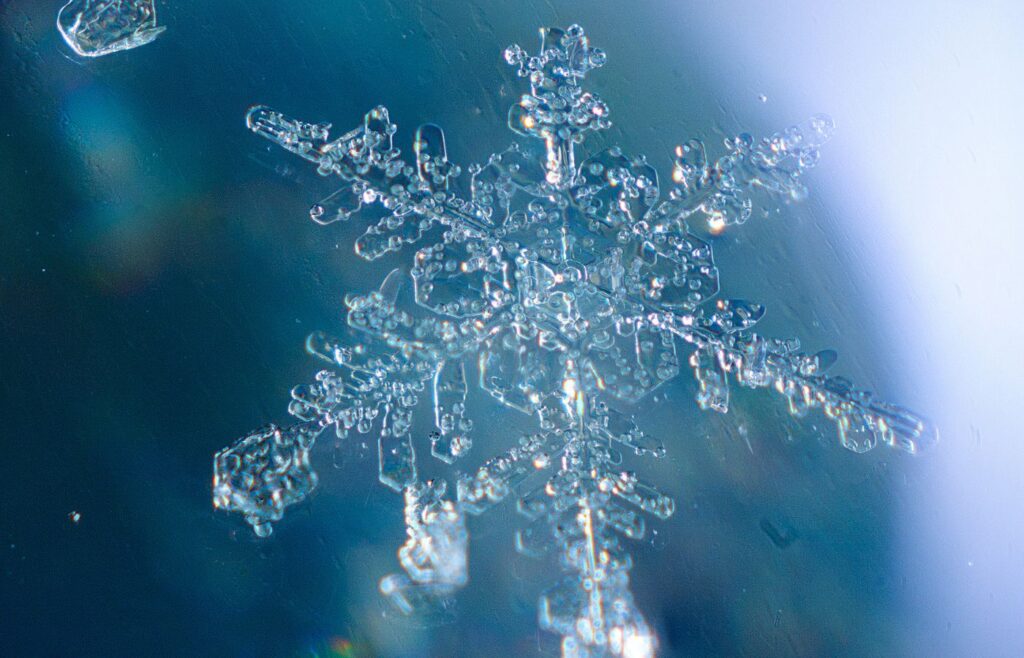
7. Probably no two snowflakes are exactly the same.
But they can look alike. One scientist found two identical snow flakes from a snowstorm in Wisconsin.
8. Snowflakes can be symmetrical six-sided shapes.
Like the ones you make from a piece of paper!
9. A snowflake is made of frozen water, so it has two hydrogen atoms and one oxygen atom (H2O).
Water molecules are shaped like a V, so when they align and freeze together, a hexagon shape develops.
10. Snowflakes can also be irregular and have different shapes.
11. There are 35 different types of snowflakes.
Science blogger Andy Brunnin has painstakingly catalogued 35 different types of snowflakes:
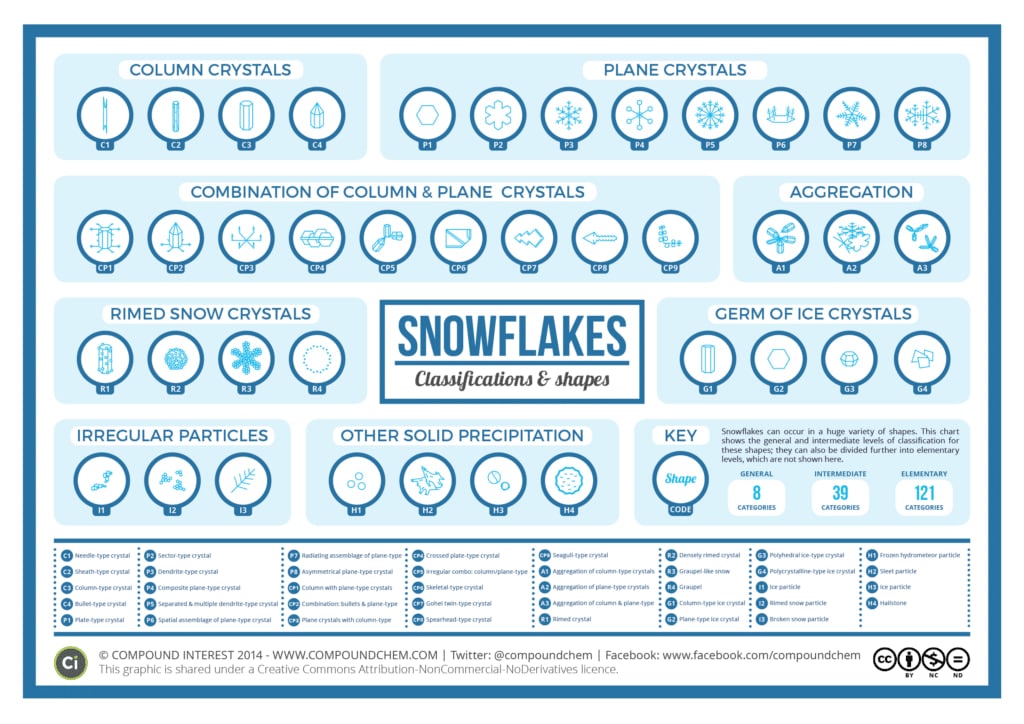
12. The air temperature around a snowflake determines its shape.
Needle-like crystals form at 28 degrees F, while low temperatures of 23 degrees F will lead to flat crystals.
Cool Snowflake Facts
13. Snow is actually not white. It’s clear.
It appears white because of the way the sun reflects off of the ice crystals.
14. Snow can appear in a wide variety of colors.
Dust particles, pollution or fresh-water algae can color it black, orange or blue.
15. A snowstorm or winter storm is when there is a heavy snowfall and a lot of snow accumulates on the ground.
16. A blizzard is a severe snowstorm that has high winds of at least 35 mph and reduced visibility to less than a quarter miles for 2 hours or more.
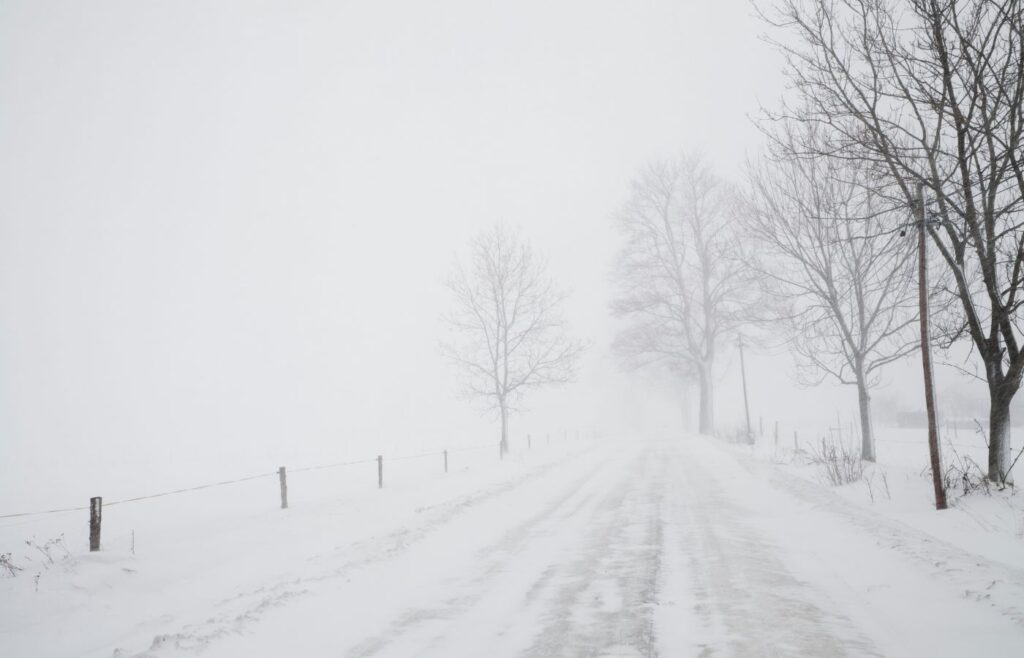
17. A ground blizzard is when it’s now snowing, but strong winds blow around loose snow, causing lower visibility and making it hard to see.
18. A “thundersnow” is a snowstorm that also has thunder, lighting, and strong winds.
19. Lake-effect snow happens when cold air moves across a large body of warm water.
Water vapor is sucked up into the cold air mass, where it freezes and falls back down as snow.
20. Snowfields are places that are covered in snow year-round.
Examples are the north pole, south pole and in high altitudes on mountaintops.
21. Snow leopards find their habitat in snowfields on mountaintops.
22. As the climate warms, the snow cover on some mountaintops has been shrinking.
This is happening a lot, especially near the equator.
Wild Snowstorms & Weather Facts
23. Snow can cause “snow blindness” because of the ultraviolet radiation it reflects.
You should always wear eye protection when you’re skiing or playing in the snow!
24. The most snow to ever fall in 24 hours happened in Capracotta, Italy on On March 5th, 2015.
100.8 inches (2.56 meters) of snow fell in a 24 hour period.
25. The highest snowfall in the United States in 24 hours fell in Silver Lake, Colorado in 1921.
75.8 inches of snow fell in a one day period.
26. The most snow to every fall in one year fell in Mount Rainier, Washington in 1971.
102 feet of snow fell in a 365-day period.
27. The world’s largest snowflake was recorded at 15 inches across and 8 inches thick.
It was found at Fort Keogh, Montana in the United States on January 28th, 1887. It’s a Guinness Book of World Record!
28. The most snow to every fall in a single day was 63 inches of snow.
It happened in Georgetown Colorado on December 4th, 1913.
29. Snow has never been reported in Key West, Florida.
30. It can be to warm too snow, but it’s never too cold to snow.
31. Snow is just one form of precipitation.
The five other forms of precipitation are drizzle, rain, sleet, graupel, and hail. (Graupel is a soft version of hail.)
32. Light and fluffy snow is often called ‘powder’.
33. Snow melts when it’s warmer than a freezing temperature of 32 degrees.
34. Frost is not snow.
Frost is made from water than was already on the ground.

35. It’s possible for snow to fall with warm air as high as 50 degrees.
But only if environmental conditions are just right!
36. When it snows with temperatures above freezing, the temperature will drop.
If the snow is falling heavily, the temperature will quickly drop to near 32 degrees. This is due to evaporation and melting, both cooling processes.
Amazing Records About Snow
37. It takes about 1 hour for a snowflake to reach the ground.
38. Most flakes fall at speeds of one to four miles per hour.
It depends on each snowflake’s size and mass and the surrounding environmental conditions.
39. The largest, heaviest snowflakes can reach speeds up to 9 mph.
40. Snow can appear in a wide variety of colors.
Dust, pollution or fresh-water algae can color it black, orange or blue.
41. Freshly fallen snow absorbs sound waves, making everything seem quieter.
42. The Inuit have 50 words for snow.
43. The Scots language has 421 terms related to snow.
Some words include ‘skelf’ (a large snowflake), ‘spitters’ (small drops of driving snow) and ‘unbrak’ (the beginning of a thaw).
44. On Mars, there are sudden violent snow storms in the summer months.
Here are more mind-blowing facts about Mars for kids!
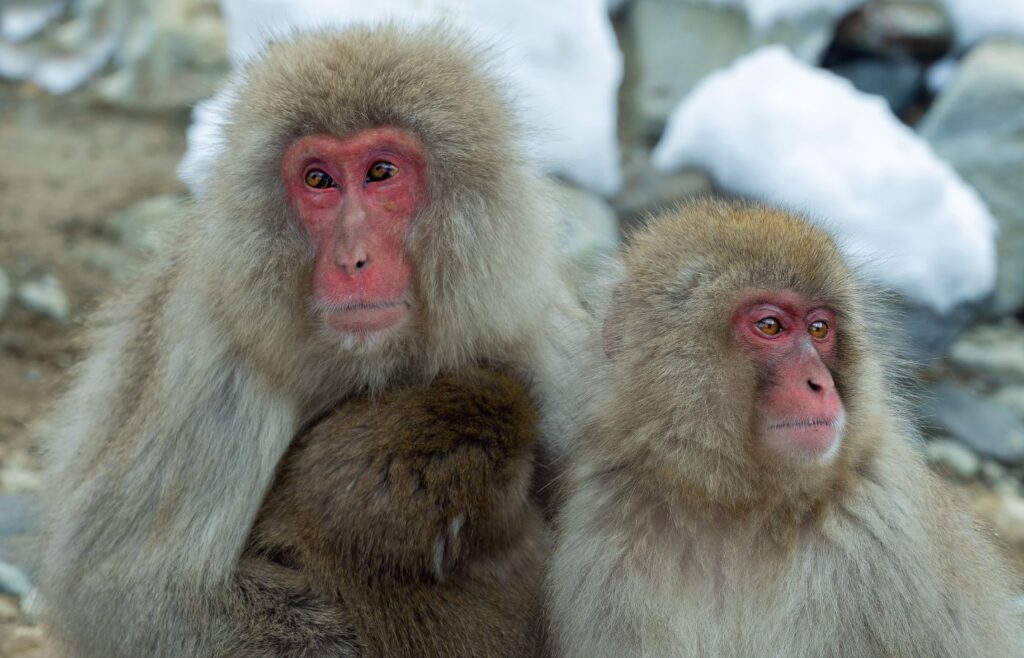
45. Monkeys have snowball fights.
Japanese macaques, or “snow monkeys” have been observed playing with snowballs! (If you love monkeys, dive into our epic list of surprising monkey facts for kids.)
46. Chionophobia is the fear of snow.
It derives from the Greek word for snow “chion”.
47. Snow is a great insulator because it is up to 95% trapped air.
This is why many animals burrow deep into the snow during winter in order to hibernate.
48. Igloos use only body heat to warm them.
They can be 100 degrees warmer inside than outside.
49. The Common Council in Syracuse, New York passed a decree that any more snow before Christmas Eve was illegal.
50. The world’s largest snowball fight took place on January 12, 2013 in Seattle.
5,834 people came together to attack each other with snowballs.
Frequently Asked Questions About Snow
Each year, at least 1 septillion snowflakes fall from the sky. That’s 1,000,000,000,000,000,000,000,000. (24 zeroes!)
Probably no two snowflakes are exactly the same. But they can look alike. One scientist found two identical snow flakes from a snowstorm in Wisconsin.
Most flakes fall at speeds of one to four miles per hour. It depends on each snowflake’s size and mass and the surrounding environmental conditions. The largest, heaviest snowflakes can reach speeds up to 9 mph. It takes about 1 hour for a snowflake to reach the ground.
Not exactly. When the air is extremely cold, it’s usually too dry for clouds to form — but if there’s moisture, snow can still fall even at very low temperatures
If your kids love fun winter stuff like this, they’ll melt over our ice puns and jokes — they’re snow funny!
We hope you loved these fun snow facts for kids as much as we do. Here’s wishing you lots of fun playing in the snow this winter — and maybe even a snow day!
Related Posts:
- Fun Christmas Trivia Questions For Kids
- Fun Facts About Hockey Your Kids Will Love
- Emperor Penguin Facts for Kids
- Thanksgiving Facts for Kids
- Rainbow Facts for Kids
- 25 Magnificent Winter Birds in Wisconsin

Calie Herbst, Editor-in-Chief of Milwaukee With Kids, has spent over a decade combining her experiences as a parent of three to create a hub for Milwaukee’s family adventures.
Her decade-long teaching career in Milwaukee Public Schools and academic background, including a Master’s in Teaching from Marquette University and dual B.A.s in Sociology and Spanish from the University of Wisconsin – Madison, fuel her passion for inclusive and engaging family content.
Calie is also a recognized voice in local media, contributing to WISN Channel 12 News, WTMJ Wisconsin Morning News, Fox 6’s Real Milwaukee, and B93.3.
Discover more about Calie’s journey and editorial approach on her About Page and Editorial Policy Page.