

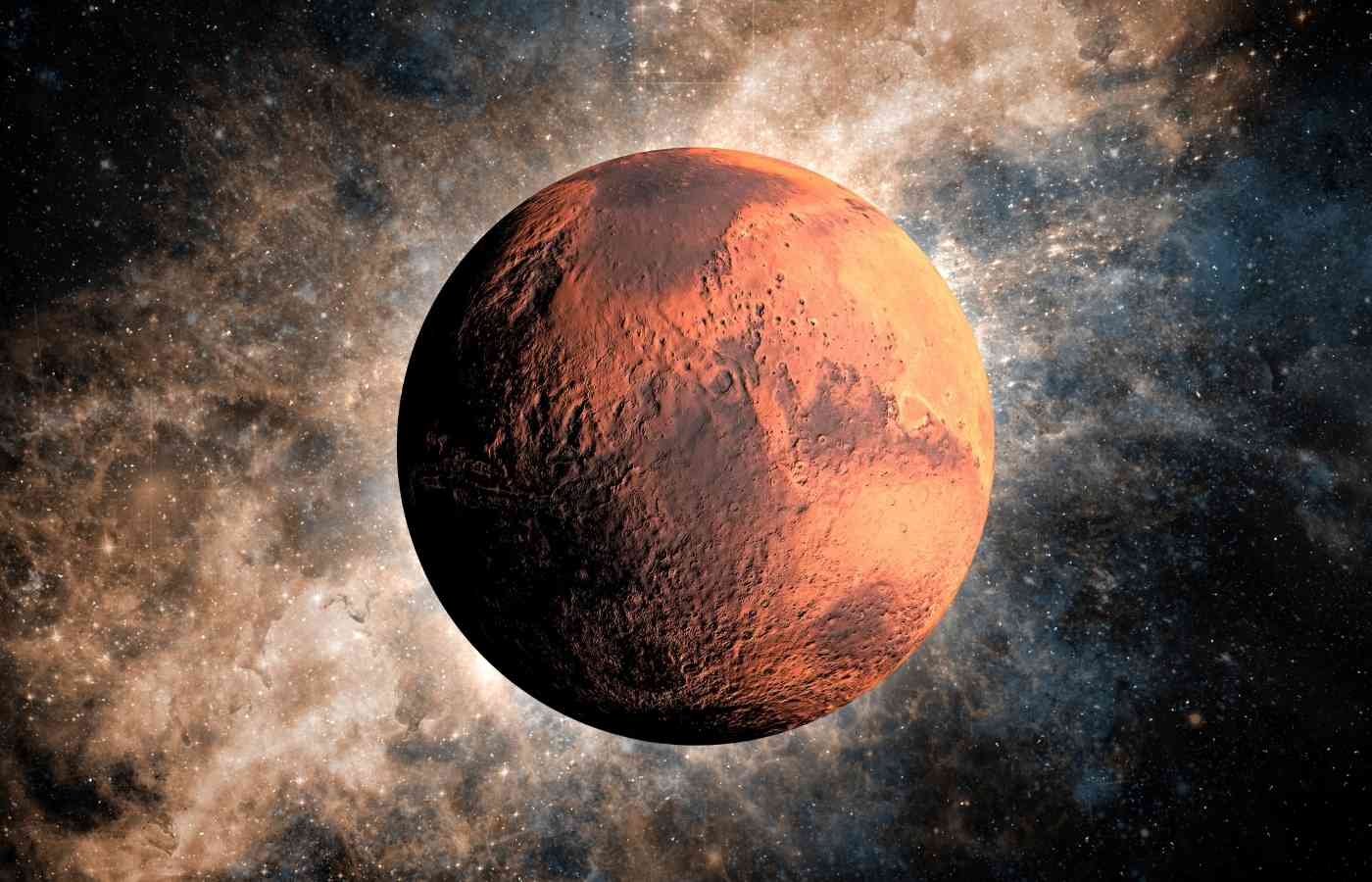

Looking for fun, kid-friendly facts about Mars? This updated list includes 50 fascinating Mars facts for kids, perfect for school projects, space units, trivia games, and curious young astronomers. Each fact is short, accurate, and easy to understand — with surprising details kids actually remember.
💡Ready to explore beyond Mars? Our stellar collection of incredible fun facts for kids covers the entire universe and more — from planets and space to animals, weather, and science topics kids love.
Quick Picks: Mind-Blowing Mars Facts Kids Love
Try these first for instant “wait… really?!” reactions:
- Mars has the tallest volcano in the solar system. Olympus Mons is nearly three times taller than Mount Everest.
- A year on Mars is almost twice as long as a year on Earth. One Mars year lasts 687 Earth days.
- You’d weigh much less on Mars. Gravity on Mars is only about 38% of Earth’s, so jumping would be way easier.
- Mars has planet-wide dust storms. Some storms grow so large they can cover the entire planet for months.
- Mars has two tiny, potato-shaped moons. Phobos and Deimos are much smaller than Earth’s moon.
- Scientists have found strong evidence of ancient water on Mars. River valleys, lakebeds, and minerals suggest Mars once had flowing water.

10 Quick Mars Facts for Kids
These 10 quick facts give kids a fast, easy overview of Mars – perfect for school projects, trivia, or a quick introduction to the Red Planet.
1. Mars is the fourth planet from the Sun.
Simple orientation fact — great for “Mars for kids” intent.
2. Mars is called the “Red Planet.”
High-recognition, kid-friendly hook.
3. Mars is about half the size of Earth.
Immediate comparison kids understand.
4. Mars is the second smallest planet in the solar system.
Helpful context without being abstract.
5. Mars formed about 4.5 billion years ago.
Classic science fact teachers expect.
6. Mars has a hard, rocky surface.
Introduces “terrestrial planet” without jargon overload.
7. Mars has two small moons named Phobos and Deimos.
Memorable + fun (names stick).
8. A day on Mars is slightly longer than a day on Earth.
Time-based facts perform very well in snippets.
9. Gravity on Mars is much weaker than on Earth.
Sets up jumping/weight facts kids love.
10. Scientists have found evidence that Mars once had water.
Biggest curiosity driver + exploration hook.
Mars vs Earth: A Kid-Friendly Comparison
Wondering how Mars compares to Earth? This quick chart makes it easy to see the differences at a glance.
| Feature | Earth | Mars |
|---|---|---|
| Length of a Day | 24 hours | 24 hours, 37 minutes |
| Gravity | Stronger gravity | About 38% of Earth’s gravity |
| Size | Larger planet | About half the size of Earth |
| Temperature | Supports life | Very cold (average −80°F) |
| Moons | 1 moon | 2 small moons (Phobos & Deimos) |
50 Fascinating Facts About Mars for Kids
Basic Mars Facts
- The planet Mars is named after the Roman God of war because of its red color that symbolized blood.
- Mars is the fourth planet from the Sun.
- Mars is the second smallest planet in the solar system (after Mercury).
- Mars is about half the size of Earth.
- If the Sun were as tall as a typical front door, Earth would be the size of a dime, and Mars would be about as big as an aspirin tablet.
- Just like Earth, the surface of Mars is hard and rocky. This means it is a “terrestrial planet.”
- Although Earth is much bigger than Mars, they both have approximately the same amount of land because most of Earth is covered in water.
- Mars is called the “Red Planet” because its soil has a lot of iron, which rusts and gives Mars its red color.
- Martian “soil” is called regolith.
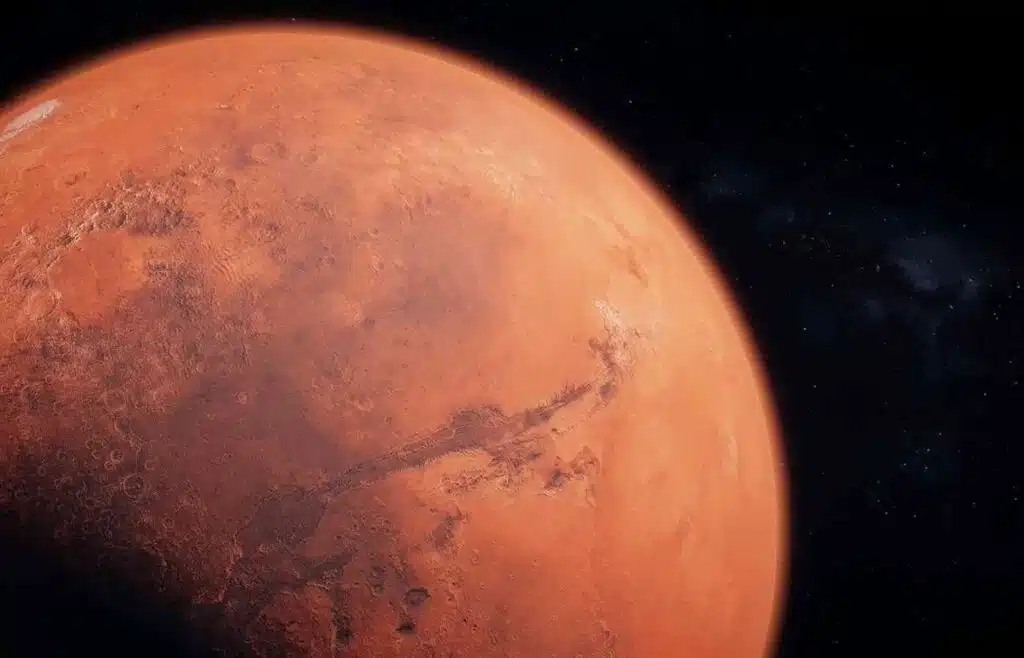
- Mars has many more colors than just red, including gold, tan, and brown.
- Earth and Mars are the only two planets in the solar system with polar ice caps made of carbon dioxide (dry ice).
Mars Size, Gravity & Time
- Mars measures about 4,219 miles across.
- Mars is an extremely cold planet. Temperatures can reach 68°F at the equator and dip to -284°F at the poles.
- Mars has two moons, named Phobos and Deimos.
- A day on Mars is 24 hours and 37 minutes long.
- A Martian day is called a sol.
- A year on Mars is 687 Earth days long.
- Mars’s gravity is only about 38% of Earth’s gravity.
- You could jump much higher on Mars because gravity is weaker there.
- You would weigh much less on Mars than on Earth.
Mars Weather & Surface
- Mars has the largest dust storms in the solar system.
- Mars dust storms can reach wind speeds of up to 125 miles per hour.
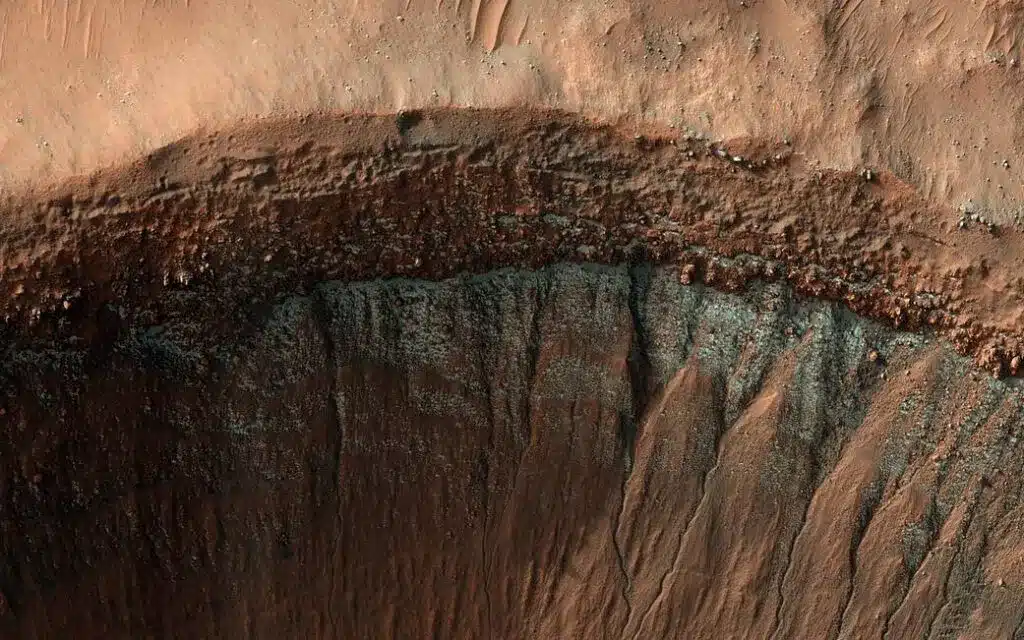
- More than 43,000 craters have been found on the surface of Mars.
- The northern hemisphere of Mars is relatively smooth and has fewer craters.
- The southern hemisphere of Mars has many craters and highlands.
- Hellas Planitia is a massive crater over 3.7 miles deep.
- Mars has channels that look like they were formed by flowing water.
- Mars has a very thin atmosphere, about 100 times thinner than Earth’s.
- Mars has seasons like Earth, but they last longer.
- The longest season on Mars is spring, lasting 194 days.
- The shortest season on Mars is autumn, lasting 142 days.
- The atmosphere on Mars is too thin for liquid water to remain on the surface.
- Mars’s atmosphere is mostly made of carbon dioxide, nitrogen, and argon.

Moons, Volcanoes & Landforms
- The moon Phobos is slowly moving toward Mars and may crash into it in the distant future.
- The moons of Mars are potato-shaped because they are too small for gravity to make them round.
- Mars has the tallest volcano in the solar system, called Olympus Mons.
- Mars also has the largest canyon in the solar system, called Valles Marineris.
Mars Exploration & Rovers
- Low gravity on Mars could cause weaker bones for humans over time.
- No human has ever set foot on Mars.
- There is very little oxygen on Mars, so humans would need spacesuits.
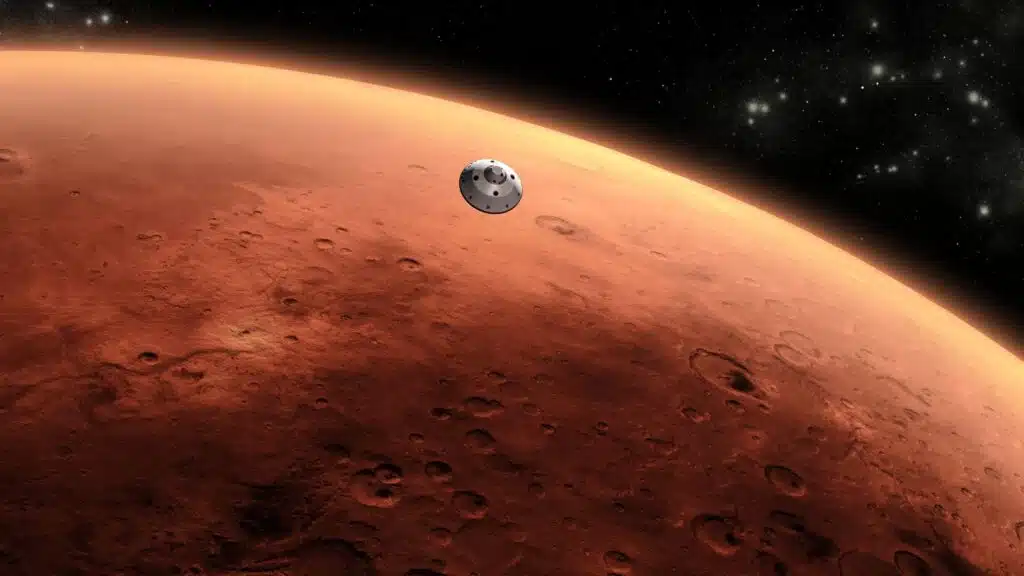
- The first spacecraft to land on Mars were the Viking Landers in 1976.
- The first Mars rover was Sojourner, which landed in 1997.
- Spirit and Opportunity landed on Mars in 2004.
- NASA’s Curiosity rover discovered evidence of ancient water.
- Perseverance is the fifth rover to land on Mars and drills into the surface.
- Pieces of Mars have landed on Earth as meteorites.
- Galileo Galilei first observed Mars with a telescope in 1610.
- Mars is about 141.6 million miles away from the Sun.
- The Sun appears about half the size on Mars compared to Earth.
- Sunlight takes about 13 minutes to reach Mars.
- The month of March is named after Mars.
- Mars is visible from Earth without a telescope.
- Jupiter is the largest planet and is more than 20 times wider than Mars.
- In the 1800s, astronomers once believed Mars had canals.
- Mars is likely the first planet humans will visit.
- Mars shows evidence of ancient river valleys and lakebeds.
- Some features suggest Mars had massive floods billions of years ago.
- Mars may have once been hospitable for life.
- Only 18 out of 40 Mars missions have been successful.
- Mariner 4 sent the first close-up images of Mars in 1965.
- Mariner 9 became the first spacecraft to orbit Mars in 1971.
- Sojourner was the first wheeled rover to explore Mars.
- Spirit and Opportunity confirmed Mars once had liquid water.
- In 2021, China became the second country to successfully land on Mars.

Want to see real rockets up close? We visited the Kennedy Space Center with our kids (twice!) and shared everything you need to know.
Books About Mars for Kids
Want to go deeper? These kid-friendly books about Mars are great for curious readers, school projects, and space units at home or in the classroom.

Mars (Elizabeth Carney and National Geographic Kids)
This nonfiction book introduces Mars using clear facts and real photographs. It explains rovers, surface features, and space missions in simple language.

Mars! Earthlings Welcome (Stacy McAnulty)
This picture book lets Mars tell its own story with humor and charm. Fun illustrations make space concepts easy and engaging for young readers.

Mars: The Red Planet (Elizabeth Carney and National Geographic Kids)
This book explores Mars through geology, robotics, and human exploration. Photos and short sections make complex ideas approachable.
Frequently Asked Questions About Mars
No, Mars is not bigger than Earth. Mars is about half the size of Earth and measures about 4,219 miles across. Mars is the second smallest planet in the solar system (after Mercury). If the Sun were as tall as a typical front door, Earth would be the size of a dime, and Mars would be about as big as an aspirin tablet.
Just like Earth, the surface of Mars is hard and rocky, which makes it a terrestrial planet. You could walk on it! Mars is not a gas giant like Jupiter or Saturn. Mars is called the “Red Planet” because its soil contains a lot of iron. When the iron rusts (turns into iron oxide), it gives Mars its red color.
Mars is an extremely cold planet because it is farther from the Sun than Earth. At the equator, temperatures can reach about 68°F, but at the poles they can drop as low as −284°F. The average temperature on Mars is around −80°F. Earth and Mars are the only two planets in the solar system with polar ice caps, which are made of solid carbon dioxide (dry ice).
Mars does not have liquid water on its surface today because its atmosphere is too thin. However, scientists have found strong evidence of ancient river valleys, lakebeds, and deltas, as well as minerals that only form in the presence of liquid water. Some features suggest Mars experienced massive floods around 3.5 billion years ago.
Yes! Mars has two small moons named Phobos and Deimos. Both moons are much smaller than Earth’s moon and are oddly shaped, like potatoes, because they are too small for gravity to make them round. The moon Phobos is slowly moving closer to Mars and may eventually break apart or crash into the planet millions of years from now.
So far, Earth is the only planet in the solar system known to support life. Mars has a very thin atmosphere — about 100 times thinner than Earth’s — which makes it difficult for life as we know it to survive. However, scientists believe Mars may have once been more hospitable, and it remains one of the most likely places beyond Earth where signs of past life could be found.
Want to see the Red Planet up close? Explore real photos of Mars captured by NASA’s rovers and spacecraft.
👉 See more NASA photos from Mars.
More Space Facts Kids Will Love
Looking for more space facts kids will love? Keep exploring with these fun, kid-friendly guides.

Calie Herbst, Editor-in-Chief of Milwaukee With Kids, has spent over a decade combining her experiences as a parent of three to create a hub for Milwaukee’s family adventures.
Her decade-long teaching career in Milwaukee Public Schools and academic background, including a Master’s in Teaching from Marquette University and dual B.A.s in Sociology and Spanish from the University of Wisconsin – Madison, fuel her passion for inclusive and engaging family content.
Calie is also a recognized voice in local media, contributing to WISN Channel 12 News, WTMJ Wisconsin Morning News, Fox 6’s Real Milwaukee, and B93.3.
Discover more about Calie’s journey and editorial approach on her About Page and Editorial Policy Page.