

Updated for 2026 with refreshed explanations, modern references, and resources to help you find your child’s day of the week.
Save This For Later
Can the day of the week your child was born predict their personality? According to the traditional nursery rhyme “Monday’s Child,” it just might. Parents are still searching for this rhyme in 2026, showing its staying power. Just like zodiac signs, baby name trends, and personality quizzes, this old poem taps into our timeless curiosity about what birthdays say about us.
While it’s not exactly scientific, humans have long been fascinated with finding meaning in birthdays—through astrological signs, birth locations, and yes, even the day of the week. The “Monday’s Child” rhyme dates back to at least the 19th century and is one of the most beloved examples of this tradition.
So, was this original day of the week poem simply a clever way for children to learn the days of the week, or is there something more to it?
How to Find What Day of the Week You Were Born On
To discover the day of the week you or your child was born on, use this handy calculator based on Zeller’s Algorithm. Just plug in the birth date, and voilà—the day appears! (Once you know the day, you might want to reflect on your child’s personality—or even start planning your baby nursery to match their unique traits!)
The Original “Monday’s Child” Poem (1838 Version)
The earliest known version of “Monday’s Child” was published in Traditions of Devonshire by A.E. Bray in 1838. Here’s the traditional rhyme:
Monday’s Child
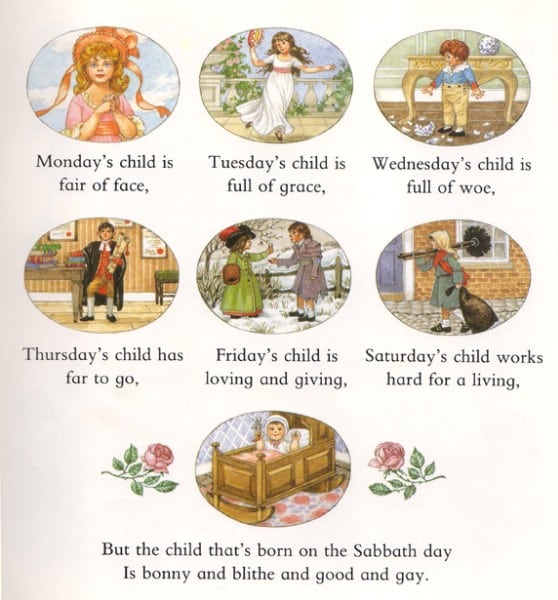
Monday’s child is fair of face,
Tuesday’s child is full of grace,
Wednesday’s child is full of woe,
Thursday’s child has far to go,
Friday’s child is loving and giving,
Saturday’s child works hard for a living,
And the child born on the Sabbath day
Is bonny and blithe, and good and gay.
Despite its simplicity, this rhyme has captivated parents for centuries, inspiring interpretations, variations, and even modern adaptations. Let’s explore what each day of the week signifies.
If you’re preparing a nursery, this classic rhyme pairs perfectly with thoughtful reading time. Check out our list of the Best Books for Your Baby’s Nursery to create a warm and inviting space for your little one.
Monday’s Child Poem: Day-by-Day Meanings Explained
Monday’s Child: “Fair of Face” Meaning
“Fair of face” means attractive, charming, or healthy-looking. Monday-born children are associated with beauty and charm, making this line a favorite among parents (who often think their kids are adorable anyway!). Some versions interpret this as a sign of health or good fortune, while others humorously suggest it might lead to vanity.
Tuesday’s Child: “Full of Grace” Meaning
“Full of grace” means graceful in movement, character, or spirit. Tuesday-born children are believed to have poise, refinement, and courtesy. Some interpretations read it as “full of God’s grace,” suggesting faith and spiritual connection. Modern takes simply see Tuesday’s child as kind and elegant.
Wednesday’s Child: “Full of Woe” Meaning
“Full of woe” means sorrowful or sensitive. Wednesday-born children are often thought to be empathetic, carrying the weight of the world while using their sensitivity to connect with and help others. Rather than being doomed to sadness, many modern parents interpret this as emotional depth. (Pop culture fans might even think of Wednesday Addams!) Jenna Ortega’s Netflix series Wednesday turned this character into a cultural icon, giving fresh life to the phrase “full of woe.”
Day-of-the-Week Notebooks
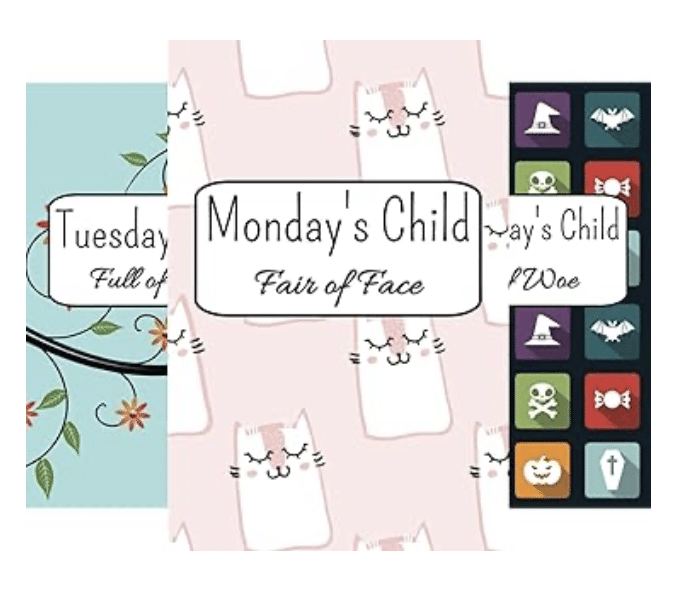
If you enjoy the Monday’s Child rhyme, there’s a whole set of notebooks inspired by it – one for each day of the week. They’re a thoughtful way to mark someone’s birthday or a simple gift idea for friends and family. See the full collection on Amazon
Thursday’s Child: “Has Far to Go” Meaning
“Has far to go” means destined for a long journey, growth, or achievement. Thursday-born children are often seen as ambitious and adventurous. While some interpret it as facing challenges along the way, others see it as a positive sign of a full life with many opportunities ahead.
Friday’s Child: “Loving and Giving” Meaning
“Loving and giving” means affectionate, generous, and loyal. Friday-born children are often thought to be warm-hearted and kind. While older traditions sometimes viewed Friday as unlucky, modern interpretations highlight the child’s generosity and ability to nurture others.
Saturday’s Child: “Works Hard for a Living” Meaning
“Works hard for a living” means diligent, dependable, and industrious. Saturday-born children are associated with strong work ethics and perseverance. Though it might suggest a life of hard labor, many see it as a sign of dedication and meaningful contribution.
Sunday’s Child: “Bonny and Blithe” Meaning
“Bonny and blithe” means cheerful, attractive, and fortunate. Sunday-born children are thought to be joyful, blessed, and naturally lucky. Historically, this day was linked to rest and good fortune, making these children especially favored.
Different Versions of the “Monday’s Child” Poem
If the original doesn’t resonate, don’t worry! Here are a few alternate versions of the rhyme that may suit your perspective:
Variation 1
Sunday’s child is full of grace
Monday’s child is full in the face
Tuesday’s child is solemn and sad
Wednesday’s child is merry and glad
Thursday’s child is inclined and thieving
Friday’s child is free in giving
Saturday’s child works hard for a living
Variation 2
Born on Monday, fair of face;
Born on Tuesday, full of grace;
Born on Wednesday, merry and glad;
Born on Thursday, wise and sad;
Born on Friday, Godly given;
Born on Saturday, earn a good living;
Born on Sunday, blithe and gay
Variation 3
Sunday’s child is full of grace,
Monday’s child is fair of face;
Tuesday’s child loves to race,
Wednesday’s child is kind of heart;
Thursday’s child is very smart,
Friday’s child will never part;
Saturday’s child is good of heart
Variation 4
Born of a Monday, Fair in face;
Born on a Tuesday, Full of God’s grace;
Born of a Wednesday, Merry and glad;
Born of a Thursday, Sour and sad;
Born of a Friday, Godly given;
Born of a Saturday, Work for your living;
Born of a Sunday. Never shall we want;
So there ends the week, And there’s an end on’t.
Variation 5
Born of a Monday, Fair in face;
Born on a Tuesday, Full of God’s grace;
Born on Wednesday, Sour and sad;
Born on Thursday, Merry and glad;
Born on a Friday, Worthily given;
Born on Saturday, Work hard for your living;
Born on Sunday, You will never know want.
Variation 6
Monday for health,
Tuesday for wealth,
Wednesday best day of all,
Thursday for crosses,
Friday for losses,
Saturday no luck at all.
He who’s born on the day of rest
In health and fortunes has the best.
A Modern Take on the Rhyme
Humorist Bruce Larkin offered a playful parody of the traditional “Monday’s Child” poem, focusing on childhood ailments instead of personality traits:
Monday’s Child is Ill
Monday’s child is ill, I’m told.
Tuesday’s child has caught a cold.
Wednesday’s child is down with the flu.
Thursday’s child is feeling blue.
Friday’s child can’t eat any food.
Saturday’s child is in a foul mood.
And the child that’s born on the seventh day
Is the only child that feels okay.
It’s a lighthearted reminder not to take these rhymes too seriously!
Days of the Week Song
For a modern twist, here’s a cheerful song that helps kids learn the days of the week, sung to the tune of the Addams Family theme:
Days of the Week (snap, snap)
Days of the Week (snap, snap)
Days of the Week, Days of the Week, Days of the Week! (snap, snap)
There’s Sunday and there’s Monday,
There’s Tuesday and there’s Wednesday,
There’s Thursday and there’s Friday,
And then there’s Saturday!
Days of the Week (snap, snap)
Days of the Week (snap, snap)
Days of the Week, Days of the Week, Days of the Week! (snap, snap)
Frequently Asked Questions About the “Monday’s Child” Poem and Meanings
“Fair of face” means attractive, charming, or healthy-looking. In the poem, it suggests that children born on Monday are associated with beauty or good fortune.
“Full of grace” means graceful in movement, character, or spirit. Tuesday-born children are often thought to have poise, kindness, and refinement.
“Full of woe” means sorrowful or sensitive. Rather than predicting sadness, many interpret this line as a sign that Wednesday-born children are empathetic, compassionate, and emotionally aware.
“Has far to go” means a long journey or much to accomplish in life. Thursday-born children are often seen as ambitious and adventurous, with many opportunities ahead.
“Loving and giving” means affectionate, generous, and loyal. Friday-born children are thought to be kindhearted and nurturing.
“Works hard for a living” means diligent, dependable, and industrious. Saturday-born children are associated with strong work ethics and perseverance.
“Bonny and blithe” means cheerful, attractive, and fortunate. Sunday-born children are traditionally seen as joyful, lucky, and blessed.
The earliest known version was published in Traditions of Devonshire by A.E. Bray in 1838. Since then, it has been passed down in many variations.
The “Monday’s Child” poem is a traditional nursery rhyme that associates personality traits with the day of the week a child is born. It first appeared in Traditions of Devonshire by A.E. Bray in 1838 and has been passed down through generations.
You can use this Day of the Week Calculator. Just enter your birth date, and it will tell you the day of the week. The calculator uses Zeller’s Algorithm, which works for any date between 1582 and 4902.
Yes! Over the years, many versions of the poem have emerged, with slight differences in wording and interpretations. Some versions even switch the traits of specific days or add religious and cultural elements.
Not at all. The poem is purely whimsical and not based on scientific evidence. It’s more of a fun tradition than a predictive tool, so take its meanings with a grain of salt.
For centuries, people have turned to traditions and superstitions to decide on the “best” day for important life events—including weddings.
According to a poem published in Proceedings of the American Philosophical Society, Vol. 25, these are the predictions for choosing a wedding day:
Monday for health,
Tuesday for wealth,
Wednesday the best day of all,
Thursday for losses,
Friday for crosses,
Saturday no day at all.
Believe it or not, even sneezing has been the subject of traditional rhymes! Here’s a classic version that ties your sneezes to fortune:
Sneeze on a Monday, you sneeze for danger;
Sneeze on a Tuesday, you kiss a stranger;
Sneeze on a Wednesday, you receive a letter;
Sneeze on a Thursday, you’ll get something better;
Sneeze on a Friday, expect great sorrow;
Sneeze on a Saturday, meet a sweetheart tomorrow;
Sneeze on a Sunday, your safety seek—
The devil will chase you the whole of the week.
One of the most peculiar day-related traditions comes from Elizabethan writer Thomas Nashe, who warned about nail-cutting superstitions. According to his rhyme:
Cut your nails Monday, you cut them for news;
Cut them on Tuesday, a pair of new shoes;
Cut them on Wednesday, you cut them for health;
Cut them on Thursday, ’twill add to your wealth;
Cut them on Friday, you cut them for woe;
Cut them on Saturday, a journey you’ll go;
Cut them on Sunday, you cut them for evil—
All the week long, you’ll be ruled by the devil.
This one’s a little absurd—but hey, maybe avoid trimming on Sundays, just in case?
Whether you’re using this rhyme as a whimsical tradition or simply enjoying its charm, it’s a fun way to celebrate your child’s unique personality. If poetry is your thing, you might also enjoy sharing themed verses with your little ones. Take a look at our Valentine’s Day Poems for Kids post for heartwarming ideas to brighten your family’s special moments.

Calie Herbst, Editor-in-Chief of Milwaukee With Kids, has spent over a decade combining her experiences as a parent of three to create a hub for Milwaukee’s family adventures.
Her decade-long teaching career in Milwaukee Public Schools and academic background, including a Master’s in Teaching from Marquette University and dual B.A.s in Sociology and Spanish from the University of Wisconsin – Madison, fuel her passion for inclusive and engaging family content.
Calie is also a recognized voice in local media, contributing to WISN Channel 12 News, WTMJ Wisconsin Morning News, Fox 6’s Real Milwaukee, and B93.3.
Discover more about Calie’s journey and editorial approach on her About Page and Editorial Policy Page.