
Hopscotch is a classic children’s game that has been enjoyed for generations. With simple rules and minimal equipment, it’s one of the easiest ways to get kids outside and moving.
You might even remember playing hopscotch yourself as a child!
In this guide, I’ll show you the basic rules of hopscotch, how to draw the court, and fun variations to try. We’ll also explore the history of this timeless chalk game and the many benefits it offers kids of all ages.
💡Looking for more screen-free activities? Our at-home activity collection for kids will help inspire you!
How to Play Hopscotch (Step-by-Step)
Time needed: 15 minutes
Hopscotch is a classic playground game that kids can play almost anywhere. It’s easy to set up, only takes a few minutes to learn, and helps children build balance, coordination, and focus while having fun.
- Draw your court
Create a traditional hopscotch grid with numbered squares (1–10) using chalk or tape.
- Toss the marker
Stand behind the starting line and toss the marker into square one. If it lands outside or on a line, your turn is over.
- Hop through the squares
Hop on one foot through the court, skipping the square with the marker.
- Pick up the marker
When you reach the square just before the marker, balance carefully, bend down, and pick it up.
- Hop back to the start
Turn around and hop back through the grid, again skipping the square with the marker.
- Move to the next square
If you complete the round without mistakes, toss the marker into the next number and repeat.
- Keep going
Continue until you’ve tossed the marker into every square. The challenge is to finish the whole course without losing balance.
What you need:
- Chalk (for outdoors) or painter’s tape (for indoors)
- A small marker (stone, bean bag, bottle cap)
- A flat space to draw the grid
Pro tip: Flat stones work best — round ones bounce too much!
Basic Rules of Hopscotch
One of the best things about hopscotch is how simple it is. Even younger kids can learn quickly with just a little practice.
Here are the rules:
- Toss a small object (stone, bean bag, bottle cap) into the first square of the grid. If it lands outside or on the line, the turn is over.
- Hop on one foot through each square until you reach the one with the marker.
- Pick up the object while staying balanced, then hop back to the start—skipping that square.
- If you finish without stepping on lines or losing balance, move on to the next number.
- If you make a mistake, your turn ends and the next player goes.
There doesn’t have to be a “winner.” The goal of hopscotch is to challenge yourself, practice balance, and have fun.
Pro tip: Choose a flat stone instead of a round one. It makes the toss easier!
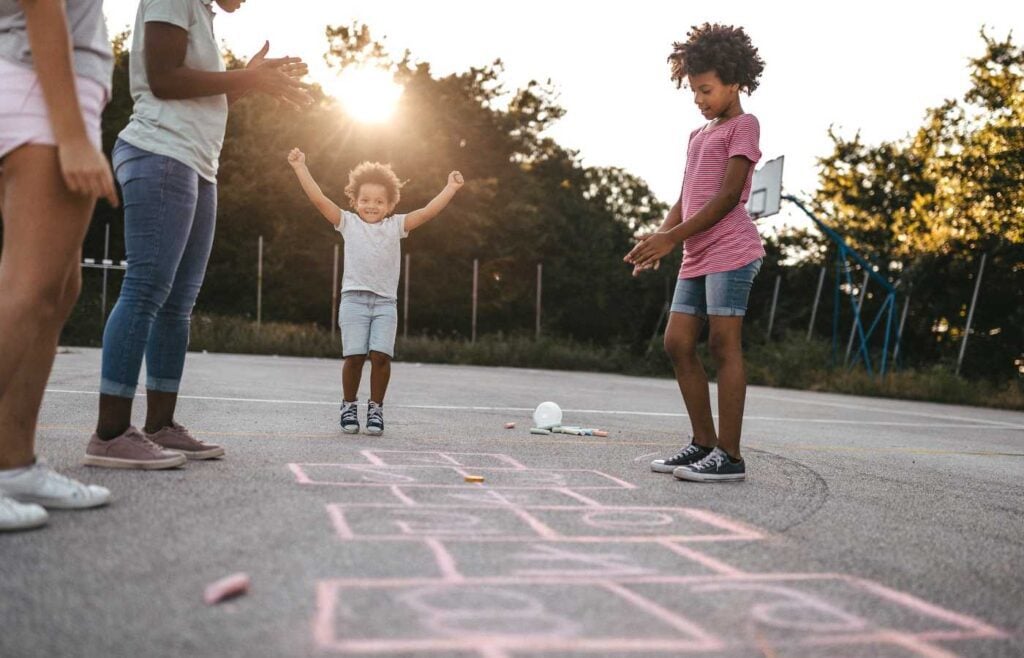
Want more inspiration? Here are more fun sidewalk chalk activities your kids will love.
How To Draw A Hopscotch Board
Outdoors Version (Chalk)
Grab some sidewalk chalk and draw your grid on a flat surface like a driveway, sidewalk, or playground. Chalk is bright, easy to use, and washes away with water.
Indoors Version (Tape)
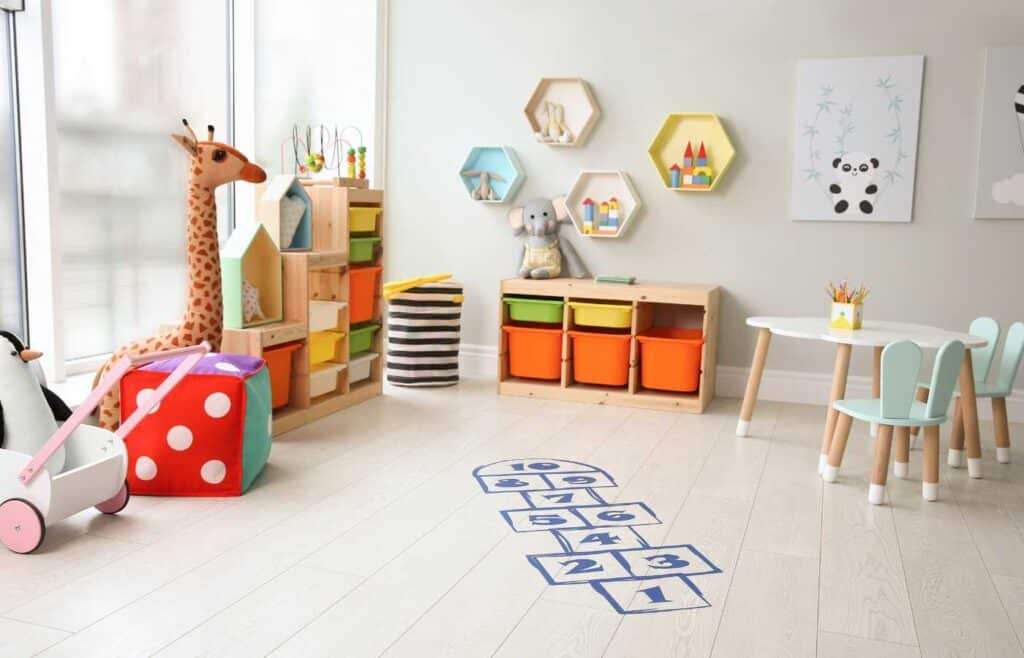
If you’re stuck inside, use masking tape, painter’s tape, or duct tape to mark the squares on the floor. Tape is a great option for rainy days or winter months.
Traditional Layout
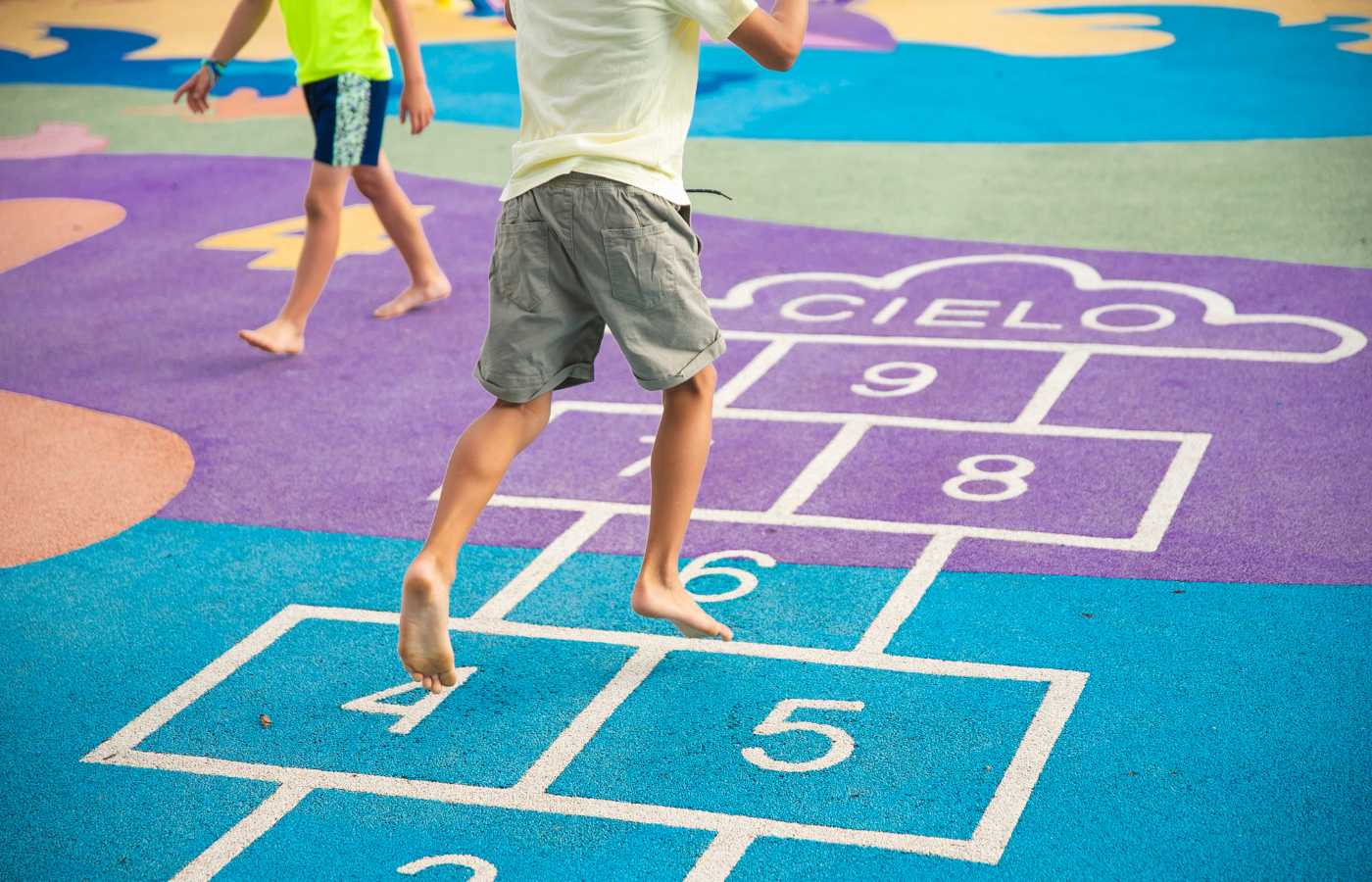
The standard hopscotch design looks like this:
- A half-circle at the top labeled “10.”
- A single square below it with a “9.”
- Two side-by-side squares for “7” and “8.”
- Another single square for “6.”
- Two side-by-side squares for “4” and “5.”
- Three single squares for “3,” “2,” and “1.”
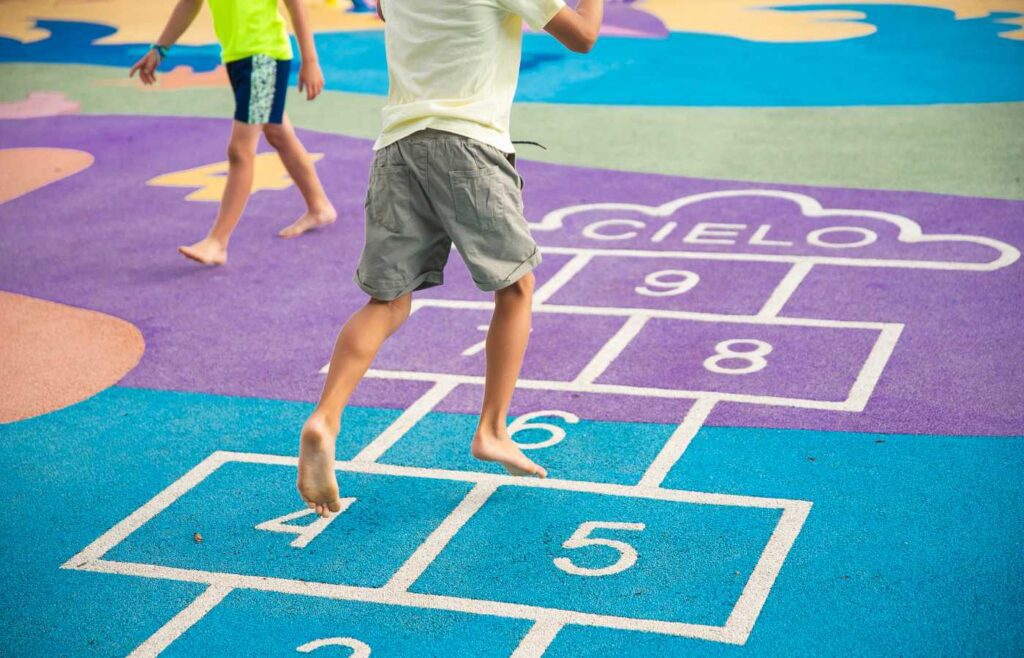
Some versions put “1” and “2” side by side. Others use spirals or creative shapes. However you draw it, the basic rules of hopscotch stay the same.
Spiral Layout
For a fun variation, draw your court in a spiral shape. Start in the center and work your way outward with numbered squares. Kids hop in and out of the spiral, adding an extra challenge as they navigate the curves.
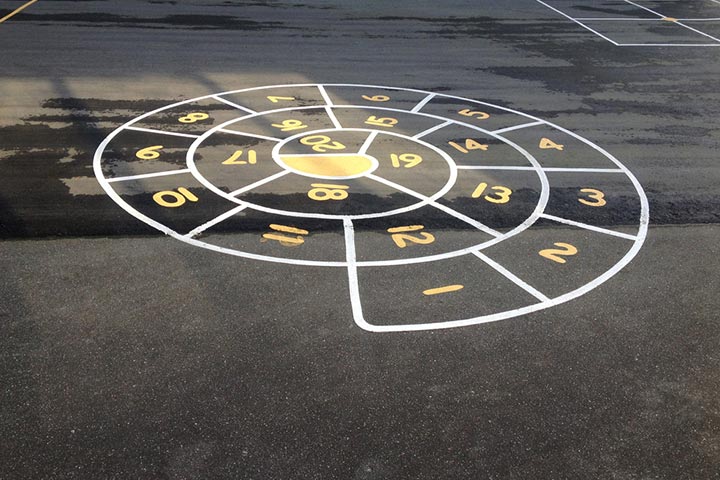
Hopscotch is a great addition to any outdoor celebration. Get more birthday party ideas for kids by age and activity to round out your party plans.
Fun Hopscotch Variations
Once your kids master the classic version, try mixing things up:
Random Toss
Instead of going in order, toss the marker into any square and start from there.
Timed Runs
Set a timer for 30 seconds (or longer) and see if players can finish in time. Great for competitive kids!
Can You Kick It?
Kick the marker forward with your hopping foot as you go through the course.
Categories
Write categories in each square (animals, foods, books). Players must call out something in that category when they land.
Rearrange the Grid
Draw a new design instead of the traditional court. Spirals, zigzags, or even custom patterns keep the game fresh.
Obstacle Course
Add special rules like “spin,” “hop backward,” or “jump twice.” This makes the grid feel like a real-life board game.

Need more screen-free activity ideas? Check out our list of 100 boredom buster activities.
Benefits of Hopscotch
This classic and simple game is much more than meets than eye. Besides being a whole lot of fun, Hopscotch offers a whole host of benefits to its players. It especially helps young kids to:
Increase Physical Activity
Kids will increase physical activity as they engage in this active hopping game.
Master Body Control
As they switch from one foot to the other, trying to stay within the hopscotch grid, they will gradually learn to control their own body more effectively and improve their physical agility.
Manage Body Rhythm
Good hopscotch players manager their body rhythm well as they hop from one square to the next.
Build Balance
Hopping on one foot requires balance and core strength, so hopscotch is a great way to build these skills.
Strengthen Hand/Eye Coordination
Throwing the rock into a square is a good way to help build hand-eye coordination.
Build Social Skills
Hopscotch is a social game that you play with others, so your child will build social skills while they are having fun.
History of Hopscotch
Roman Origins
The game is believed to have started in ancient Britain during the Roman Empire. Soldiers used long, hundred-foot grids for training drills while wearing heavy armor.
Children Adapt the Game
Roman children imitated the soldiers but shortened the course and added scoring, turning the drills into a playful game.
How It Spread Over Time
Hopscotch spread across Europe and around the world, taking on different designs and names. Some traditional courts even include the word “London” at the top, a nod to the old Roman road that connected Glasgow to London.
F.A.Q.
Each player tosses a small object into a square, hops through the course on one foot, picks up the object, and hops back. Avoid stepping on lines or losing balance.
Use chalk outdoors or tape indoors to draw a traditional court with numbered squares. You can also create spiral or custom designs for variety.
Try timed runs, random toss, kicking the marker, or adding categories to each square. You can also design obstacle courses with special rules.
Hopscotch improves balance, coordination, physical activity, rhythm, body control, and social skills while keeping kids entertained.
Hopscotch dates back over 1,000 years to ancient Rome, where soldiers used long hopscotch courts for military training. Children later adapted it into a game.
for
Yes! Use painter’s tape or masking tape to create an indoor hopscotch grid on your floor. It’s a perfect rainy-day activity.
Chalk or tape to draw the court, a small object like a rock or bean bag as a marker, and an open space to hop safely.
Final Thoughts
And there you have it! From the basic rules of hopscotch to creative variations and even its fascinating history, this classic playground game is proof that the simplest activities can be the most fun.
Whether you set up an indoor version with tape or draw a bright chalk court outside, hopscotch is an easy way to get kids moving, laughing, and learning new skills.
So the next time the kids are restless and need a quick boredom buster, pull out some chalk (or tape) and start hopping. You’ll win the day with almost no setup.
We’d also love to see your family in action! Tag us on Instagram (@mkewithkids) or send a photo to hello@mkewithkids.com—you might even see your game featured on our social media.
Related Post: Best Play Date Ideas for Kids & Toddlers

Calie Herbst, Editor-in-Chief of Milwaukee With Kids, has spent over a decade combining her experiences as a parent of three to create a hub for Milwaukee’s family adventures.
Her decade-long teaching career in Milwaukee Public Schools and academic background, including a Master’s in Teaching from Marquette University and dual B.A.s in Sociology and Spanish from the University of Wisconsin – Madison, fuel her passion for inclusive and engaging family content.
Calie is also a recognized voice in local media, contributing to WISN Channel 12 News, WTMJ Wisconsin Morning News, Fox 6’s Real Milwaukee, and B93.3.
Discover more about Calie’s journey and editorial approach on her About Page and Editorial Policy Page.